

How to Read a Chinese Zupu: A Diaspora Descendant’s Guide
The Book That Was Written for You
Every few years, someone inherits a book they cannot read. Thread-bound, paper soft with age, characters printed vertically in a classical Chinese no one in the family studied. It is a zupu (族谱 zúpǔ) — a clan genealogy, also called jiapu (家谱 jiāpǔ) or zongpu (宗谱 zōngpǔ) depending on region. Strictly, the names differ in scope — jiapu records a single family line, zupu the whole clan — but in practice they are used interchangeably. And the first thing to know: the book was written for you.
Not for scholars. For descendants — a category that includes everyone holding the book today, generations late but never excluded.
That is the key to how to read a Chinese zupu, because it explains why the book looks the way it does. Every zupu was compiled for one stated purpose, a phrase you will meet in its first pages: 敬宗收族 (jìng zōng shōu zú) — honor the ancestors, unite the lineage. The book binds a family across time, speaking backward to the dead and forward to the unborn.
The purpose is ancient. By the Wei and Jin dynasties genealogy was state business; the Song scholar Zheng Qiao (郑樵) summed it up: “官之选举,必由于簿状,家之婚姻,必由于谱系” — official appointment ran on the registers, marriage on the genealogies. In the Song, private families took over the genre: Ouyang Xiu and Su Xun each designed a chart format, and their rival designs survive in every zupu since. The Ming-Qing boom made the family book near-universal — most surviving zupu date from those centuries. After 1949 the practice nearly died, then revived in the 1980s, much of it funded by overseas Chinese.
Because the purpose stayed constant, the book became standard. Recurring parts. A fixed reading order. A fixed entry format. A fixed naming code. The wall of classical Chinese is not a wall — it is a locked door, and the key is the same for almost every zupu ever printed. Learn the ten parts once, and almost any zupu opens.

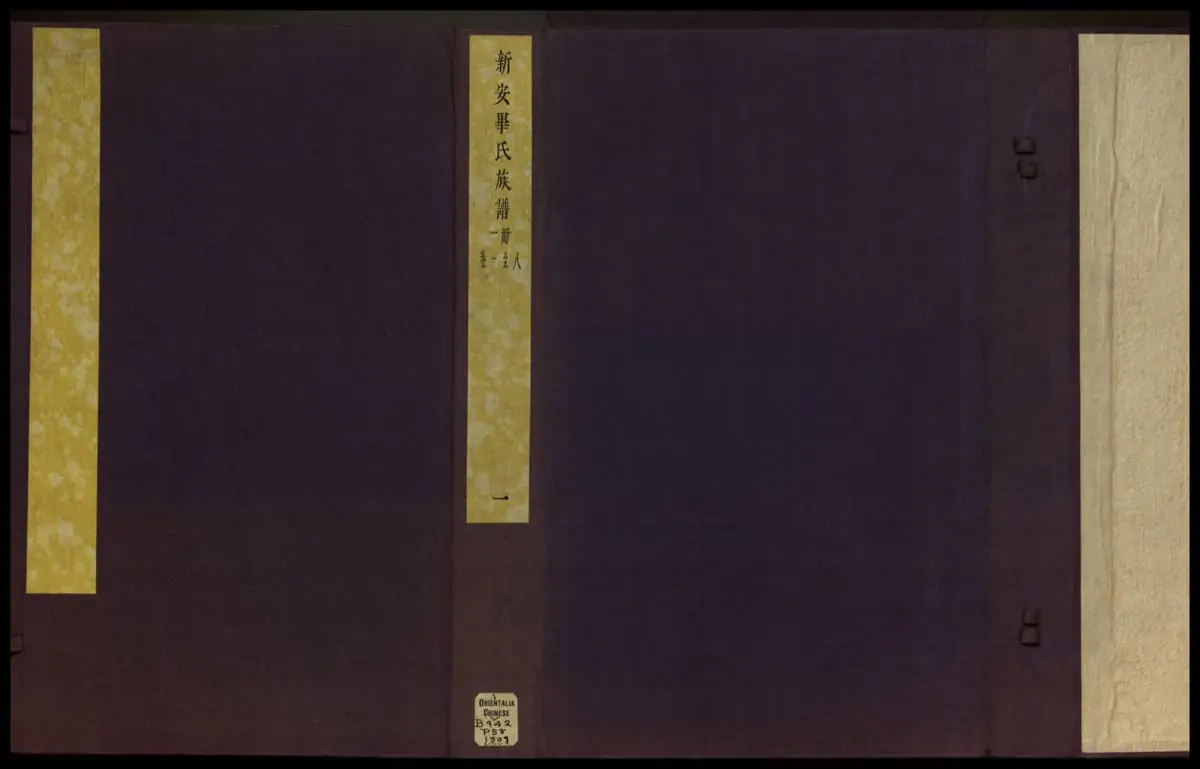
— The thread-bound cover of a Liu (柳) family zupu, its red paper title label worn but intact — the physical form of nearly every family book since the Song dynasty.
The Ten-Part Anatomy: What Is Inside Every Zupu
Open any zupu and you will find variations on the same skeleton. The body is the 世系 (shìxì) — the descent lines themselves — roughly three-quarters of the volume, split into charts (图 tú) for overview and registers (录 lù) for detail. Around that core, a standard set of parts recurs:
- 谱序 (pǔxù) — prefaces. A layered archive of every revision’s introduction.
- 凡例 (fánlì) — editorial principles. The book’s user’s manual: who is included, how generations are counted.
- 世系 (shìxì) — the descent line. The core: who begat whom, generation by generation.
- 字辈 (zìbèi) — generation characters. The verse assigning one character per generation, embedded in given names.
- 恩荣录 (ēnróng lù) — honors record. Imperial commendations, examination degrees, official appointments.
- 祠堂记 (cítáng jì) — ancestral hall records. The buildings where the lineage worships.
- 坟茔图 (fényíng tú) — grave maps. Diagrams of the burial grounds, often with compass directions.
- 艺文 (yìwén) — literary works. Essays, poems, biographies written by family members.
- 族产 (zúchǎn) — lineage property. Fields, halls, and funds owned in common.
- 领谱字号 (lǐngpǔ zìhào) — copy-distribution codes. The system that tracked who held which numbered copy.
Not every book has all ten. Small branches may carry only the core three — prefaces, principles, descent lines. But that core is the constant, and its format held steady from the Qing onward, when printing made zupu cheap for ordinary families. A book with a fixed skeleton cannot get you lost for long.

— The opening preface of a zupu, 重修盱眙吳氏族譜序 (Preface to the Revised Xuyi Wu Clan Genealogy) — the front matter is where every reading session should begin.
How to Read a Chinese Zupu: Start at the Front
The front section, the 卷首 (juànshǒu), follows a fixed order: prefaces, then the 凡例, then the descent lines. That order is your method.
Read the newest preface first. Every 续修 (xùxiū, continuation revision) adds its preface in front of the old ones. A thick zupu is a stack of historical layers; the newest layer tells you most about the book you hold — when it was compiled, who led it, what events prompted it. Then work backward through the older prefaces, which carry the family’s migration history. Mine them for facts: dates, leaders, migrations. Treat the 敬宗收族 rhetoric and ancestor praise as convention, not data.
Read the 凡例 before you interpret anything. Scholars call the editorial principles the genealogy’s “reading guide” — the book’s contract with its reader. Three checks before you trust a single entry:
- How generations are counted. The same person can appear as 15世 (shì, generation) in one book and 16世 in another. Generation numbers are ordinal positions in a line, not dates — two men both listed as 20世 can be decades apart.
- How women are recorded. Some 民国-era 凡例 added daughters; many older ones did not. The 凡例 decides what you will find — and what you will not.
- How adoption is marked, and where the reliable line starts. Look for the rules on 过继 (guòjì, adoption into the line), and check whether the book anchors on the 始迁祖 (shǐqiānzǔ, founding migrant ancestor) or a more symbolic 始祖 (shǐzǔ, first ancestor).
Three minutes in the 凡例 saves three hours of misreading.
Two Maps: Ouyang Style and Su Style
Your first analytical move with any zupu: identify which of the two rival chart formats you are looking at, because the format changes how you trace a line. The formats are named for the Song masters who invented them, and the difference is visible at a glance: tree vs. beads.
欧式 (ōu shì, Ouyang Xiu style). Five-generation charts on a horizontal grid running right to left. The rule is 五世一提 (wǔ shì yī tí) — five generations per chart, then the grid restarts. Each name carries a compact side note: courtesy name, rank, birth and death, spouse, burial place. A branching tree built for overview — scan across the generations to see the whole clan. Large lineages prefer it.
苏式 (sū shì, Su Xun style). The narrative table, sometimes called 垂珠体 (chuízhū tǐ, “hanging-bead” form). Generations hang from vertical lines — no horizontal connectors, just father-to-son strings running down the page, about five generations visible at a time. A running list that makes father-son and brother relations unmistakable. Follow the vertical line to trace one descent.
Tell them apart without reading a word: rows with side notes are 欧式; vertical strings are 苏式. You trace a line differently in each — across the rows, or down the strings.
Honest caveat: many zupu use both — 欧苏合用, Ouyang-style charts for the overview, Su-style registers for the detail. Rarer variants exist: 宝塔式 (bǎotǎ shì), a pagoda shape with the first ancestor at the peak, and 牒记式 (diéjì shì), a plain prose list. Don’t expect a clean type; expect the two dominant ones, usually both.

— A Wu family 世系图 page from the Shanghai Library collection (its seal in the margin): generations laid out in a grid — the Ouyang-style tree, scanned across the rows.

— A Qing-dynasty chart of the Jiangxia Huang family, descent lines hanging in vertical branch columns (万安派, 北郭派, 西城派) — the Su-style bead form, followed down the strings.
Decode the Names: The Generation-Character System
Now the names. Chinese given names in a zupu are not arbitrary — they encode the generation, and the code may include you. The system is 字辈 (zìbèi): a fixed sequence of characters, one per generation, usually embedded as the middle character of the given name. The sequence is written as a poem — the 派语 (pàiyǔ) — and printed in the front of the zupu, often as a separate verse page. Every boy born into the lineage receives his generation’s character; read the poem, and you can place a man in the family line within seconds.
The most famous example is the Kong clan (孔氏), descendants of Confucius. Finance minister Kong Xiangxi (孔祥熙) carried 祥; table-tennis champion Kong Linghui (孔令辉) carried 令; writer Kong Qingdong (孔庆东) carries 庆 — three men from different generations, linked by one poem. The verse shows the system’s accommodation with imperial taboo: characters that collided with emperors’ names were swapped (弘 hóng became 宏, 胤 yìn became 衍), and when the sequence ran out in 1918 the family composed a 续派 (xùpài, continuation verse) for generations 86 through 105.
The Mao family of Shaoshan worked the same way: Mao Zedong (毛泽东) is the 14th generation, bearing 泽 (zé); his father Mao Yichang (毛贻昌) bore 贻; his grandfather Mao Enpu (毛恩普) bore 恩. Read the verse, read the names, and the generations line up like beads on a string.
Diaspora families run the same logic. The Guan (关) clan of the Wuyi region carries a 32-character verse — lines like 修德象賢 (Xiū dé xiàng xián, cultivate virtue, emulate the worthy) and 君必汝顯 (Jūn bì rǔ xiǎn, you shall surely be illustrious) — a portable identity: Guan descendants of the Tan Ya Li lineage can often locate themselves by generation character alone, wherever branches kept the verse through migration. The Yimen Chen clan (义门陈氏) printed its own five-character verse in a 1901 revision, in the same spirit. For how a single surname carries identity across generations and oceans, see our look at Chinese surnames as threads of ancestry and identity.
What the system buys the reader: it disambiguates 同名 (tóngmíng, identical names), confirms which branch you belong to, and works across villages and emigrant branches. Two exceptions: 单名 (dānmíng, single-character given names) break the middle-character rule entirely, and when a poem runs out the family composes a continuation.
One more thing about that poem: it was a moral wish. The compilers chose characters meaning virtue, prosperity, wisdom, continuity, and printed them for every descendant to come. The reader may literally be named by that wish.

— A Xinhui Liang clan zupu open to its 世系 columns (90世/91世), with a descendant’s handwritten updates in pen dated 2017 — proof that the book was never finished, only continued.
The Entry Template: One Format, Everywhere
The heart of the book is the 世系录 (shìxì lù), the register of individual entries — and the standardization is almost mechanical. Every entry follows a fixed field order:
名 (name) → 字/号 (courtesy name / style name) → 生卒 (birth and death) → 配×氏 (wife, by her natal surname) → 子 (sons) → 葬地 (burial place) → 功名 (offices and honors).
Plus, depending on the compiler: 父名 (father’s name), 行次 (birth order), 享年 (age at death), and daughters recorded as 适×氏 (shì, “married to” such-and-such family). The order is centuries old — the Ming scholar Song Lian (宋濂) described exactly this shape: “讳某宇,娶某氏,生几子,葬某处,寿若干” — named so-and-so, married a woman of such a surname, had so many sons, buried in such a place, lived so many years.
The dates trip up beginners first. They are written in 干支 (gānzhī, the sexagenary cycle) plus 年号 (niánhào, reign era) — 清同治十年, the tenth year of the Tongzhi reign, converts to 1871. Online converters handle the math in seconds. Remember: generation numbers are ordinal — you cannot convert “15世” to a year; only a written date converts.
Then there is 讳 (huì). It means “tabooed name” — the respect form used when a person’s given name was taboo to write freely. “讳某” simply means “named such-and-such.” It is the first wall most readers hit — and once you know the rule, it becomes a tool.
The template also handles the awkward edges of family life: 过继 (guòjì, adopted into the line), 承祧 (chéngtiāo, continuing another branch’s ritual line), and 入赘 (rùzhuì, a husband who married into the wife’s family). These show where a descent line was spliced rather than inherited — crucial when counting generations, because adoption breaks the biological arithmetic.
And when the compilers did not know something, they wrote that too. 失考 (shīkǎo, unverified) — or 无考, or 不详 (bùxiáng, unknown) — means the person’s place in the line is clear but the details could not be confirmed. A blank is a fact, not a failure. A worked example: a 世系录 entry might read: “十三世 讳文远,字鹏举,清同治十年生,配李氏,子二:长树德,次树功,葬村北祖茔。” In the template: Thirteenth generation; named Wenyuan, courtesy name Pengju; born in 1871; wife, a woman of the Li family; two sons, Shude and Shugong; buried in the ancestral cemetery north of the village. Six fields, one template, readable.

— A Liu (柳) family 世系录 register page: five generations of entries in the fixed field order — name, courtesy name, wife’s natal surname, sons — readable once you know the template.
Find Your Branch: The Founding Migrant Ancestor
The 世系 is a forest of names, and the question is where you belong in it. Anchor on one kind of person: the 始迁祖 (shǐqiānzǔ) — the founding migrant ancestor, the first of your line to move to the place the book was written.
Do not anchor on the 始祖 (shǐzǔ). That figure is often symbolic — a famous name, a legend, a claim to glory. The 始迁祖 is the first ancestor you can usually trust, because the family remembered him in detail. His entry is the most information-dense passage in the book: 原籍 (original home) + 迁入地 (place of arrival) + 迁入年代 (date) in a single run. One Suixi County genealogy records its founding migrant in exactly this form: “明正统十一年自福建汀州府上杭县…迁居广东雷州府遂溪县” — in the eleventh year of the Zhengtong reign, from Shanghang County, Fujian, to Suixi County, Guangdong.
Three-step navigation. (1) Start from a known ancestor — a grandfather, anyone you can name. (2) Climb his line to the head of his 支 (zhī, branch), using 字辈 characters to confirm the branch. (3) Cross from the branch head to the 始迁祖, and you have the migration story in one reading.
Migration records hide in four places: the 始迁祖 entry; a 迁徙志 (qiānxǐ zhì, migration records) chapter when the family kept one; 侨居 (qiáojū, sojourning-abroad) notes beside individual entries; and, in Republican-era books, a 旅外族人名录 (lǚwài zúrén mínglù) — a register of members living overseas.
That last one is the diaspora reader’s gift. The zupu of qiaoxiang (侨乡, emigrant hometowns) tracked overseas members in place. The Wu family genealogy of Wenchang, Hainan records Wu Shize (吴世泽), who made his living in Southeast Asia and was buried in Thailand; Wu Shengyi (吴盛义), who married in Vietnam and raised three sons there; Han Jinlan (韩金兰), who left for Thailand with her husband in 1902. Where the 葬地 field should have named a village plot, it names Bangkok instead. The book that kept the lineage alive overseas is a ready-made index of your own family’s migration — the same pattern runs through every Taishanese family history and the clan associations that carried it.
Three tools identify the right book and branch. 堂号 (tánghào, hall name) — the lineage’s hall title, a branch identifier and a family-search key in one. 谱名 (pǔmíng) — the formal title, built as place + surname + format. 领谱字号 (lǐngpǔ zìhào) — the distribution code: copies numbered with characters from the Thousand Character Classic, each registered to a branch, so no outsider could claim a false lineage.
One story shows what that moment feels like. In 1997, the industrialist Rong Yiren (荣毅仁) visited the Shanghai Library and was shown the Rong family genealogy. He found his own entry: 第31世毅仁 — “31st generation, Yiren.” His name, in the line, written decades before he was born. The account comes from a single recollection published by the Overseas Chinese Affairs Office, so treat it as reported rather than documented fact — but it is the moment every reader of this guide is hoping for.

— Migration and branch records from a Liu family zupu: branch founders settling different counties, the book tracking the lineage’s dispersal on paper.
Missing Records: A Blank Is Honest
Not every generation is there. Gaps are normal, and mostly the result of two things: the rhythm of revision, and the destruction.
The rhythm: families revised on a generational cycle — commonly “thirty years a minor revision, sixty years a major one” (三十年一小修,六十年一大修). Conventions varied — some used ten and thirty, others thirty and fifty — but the principle held, and one Republican-era family rule put it bluntly: “谱宜三十年一修,若不遵此,即属不孝” — the genealogy should be revised every thirty years; failure to do so is unfilial. When war, famine, or migration skipped a revision, whole generations fell out of the record. That is what 失考 (shīkǎo) marks: a gap in detail, honestly labeled.
Then came the 20th century. Between 1949 and 1976 — most violently during the 破四旧 (“destroy the Four Olds”) campaigns of the Cultural Revolution — zupu were burned as symbols of feudal clan authority. This is the root cause of most missing records today. Some families buried their copies or carried them abroad, and those survived; most did not. When you see a gap in your family’s line, you are often seeing a loss, not a failure of record-keeping.
The recovery model exists. The Kong clan’s fifth major revision, completed in 2009 after thirteen years of work, was the largest genealogy project in Chinese history — and it gathered overseas descendants through a Hong Kong association. The ancestral halls of the emigrant villages tell the same story from the building side, and the family legacy carried in genealogies and ancestral halls explores that partnership between book and building.
If your book has gaps, rebuild from the 谱-祠-墓 (pǔ-cí-mù) triad — genealogy, hall, grave: three records of one line. 墓碑 (mùbēi) — grave steles, which often carry more names than the book. 神主牌 (shénzhǔpái) — ancestor tablets on the hall altar. 祠堂碑刻 — inscriptions in the ancestral hall. And living memory: elders who can still name the missing generations. Tomb-sweeping rituals are, among other things, a census.
Also check the neighbors. Your branch may be in another book entirely — a 房谱 (fángpǔ, branch genealogy) or 支谱 (zhīpǔ, sub-branch book) kept by a cousin village. And absence from a catalog is not loss: millions of pages survive in private hands, including books that left China with the railroad workers.

— Spirit tablets (神主牌) on the altar of the Yu Kiu ancestral hall — the hall is the second copy of the book, and grave steles are the third.
Find the Book: Digitized Collections and the Search Triple
If your family’s zupu is lost — or if you have never seen one — the finding aids are free, online, and better than most people realize.
The master index is 《中国家谱总目》 (Zhōngguó Jiāpǔ Zǒngmù, Comprehensive Catalog of Chinese Genealogies), compiled by the Shanghai Library and published in 2008: ten volumes, 52,401 entries covering 608 surnames. Its field set is itself the search vocabulary — 谱名 (title), 主修/纂修 (compiler), 始迁祖 (founding migrant ancestor), 修谱年代 (revision date), 版本 (edition), 卷数 (volume count), 收藏单位 (shōucáng dānwèi, holding institution). Every entry tells you which library holds which copy.
The search triple: 姓氏 + 谱籍 + 始迁祖 — surname, place of compilation, founding migrant ancestor. Surname alone never identifies a branch. As the scholar Wang Heming (王鹤鸣) put it: “同姓五百年前是一家,实际不一定是一家” — “people of the same surname were one family five hundred years ago; in fact, they often are not.” 同姓不同宗 (tóng xìng bù tóng zōng) — same surname, different lineage — is the rule, not the exception. Add place and founding migrant, and you collapse thousands of possibilities to one.
Two anchor collections. The Shanghai Library genealogy platform (家谱知识服务平台, jiapu.library.sh.cn) offers free full-text page images — more than 6,000 digitized zupu online by 2017, 8,000-plus by 2018. FamilySearch in Utah is the great recovery source: tens of thousands of Chinese zupu microfilmed since the 1970s, much of it from copies that survived overseas when the originals did not. Access is free, in person or through local Family History Centers. FamilySearch’s own Chinese-language guidance makes the same point as the 总目: zupu are not name-indexed — search by 始祖 or 始迁祖, 堂号, 字辈, or keywords. A third stop: 中华寻根网 (China Roots Web, ouroots.nlc.gov.cn), a joint project of the National Library of China and the Macao Foundation.
Honest limits: the 总目’s coverage stops at 2008. Post-2008 revisions are not in it — check library databases, FamilySearch, and the Shanghai Library’s in-progress catalog of genealogies since 1949. Commercial and community indexes exist too (My China Roots and jiapulib.com among them). For the research process itself — village archives, local records — see our guide to tracing Heshan ancestors; for the broader skills, how to find your ancestral village and the digital tools one family used.
Your first search, in three steps:
1. Look up the family in the 中国家谱总目 — by surname and place.
2. Refine with the triple: surname + 谱籍 + 始迁祖.
3. Note the 收藏单位 code, then request a copy from that library or view the digitized images at jiapu.library.sh.cn or FamilySearch.
When the search succeeds, a blueprint for turning a surname into a roots trip plans what comes next.

— The East Hall of the Shanghai Library — the institution behind the jiapu.library.sh.cn portal, where thousands of digitized zupu are free to read online.
Read Critically: Trust the Anchor, Question the Halo
A zupu is a family’s self-portrait, and self-portraits flatter. Read with respect and suspicion at the same time.
The standard fabrication is 攀附 (pānfù) — attaching the lineage to a famous ancestor. It was structural in Song-Ming genealogies: Li families claimed descent from Emperor Taizong of Tang (李世民), Zhang families from the Han strategist Zhang Liang (张良), Xiao families from the Han chancellor Xiao He (萧何). Sometimes the fraud was industrialized — a professional 谱匠 (pǔjiàng, genealogy artisan) sold ready-made books with famous prefaces. The classic red flag is the Zhu Xi boilerplate: a preface attributed to the Song philosopher Zhu Xi (朱熹), adopted nearly verbatim by seven or more surname genealogies, identical in every character except the surname. If every family in the county has the same “original” preface from the same famous man, it came from the printer, not the ancestors.
The useful rule of thumb is the 明中期 (mid-Ming) boundary. Treat descent lines before roughly the mid-Ming dynasty as constructed — useful for identity, unreliable for genealogy — and anchor on the 始迁祖 instead. “老谱越老越假,越近越真” — the older the line, the more likely fabricated; the closer to the present, the more reliable. With one caveat, from the historian Cang Xiuliang: even in a fabricated early line, the datable later generations still stand. You do not have to discard the book to distrust its halo.
Other red flags: a preface date that contradicts the book’s printing style; taboo violations (a name using a character that should have been avoided in its era); anachronistic offices; impossible generation arithmetic — 40 generations in about 500 years is mathematically impossible, and some books claim exactly that.
Remember the genre’s own confession. Many 凡例 state it outright: “史则善恶俱载,谱则书善而隐恶” — history records good and evil alike; the genealogy records good and conceals evil. A biased source is still a source. Read it critically; do not discard it.
Two more traps. 联宗谱 (liánzōng pǔ, merged same-surname genealogies) combine unrelated branches under one first ancestor — “this book covers my family’s surname” is not proof of kinship. And copies disagree: a 稿本 (gǎoběn, manuscript draft) is closest to the raw record; a 抄本 (chāoběn, hand copy) is the most error-prone; a 刻本 (kèběn, woodblock print) or 木活字 (mù huózì, movable wooden type) edition is standardized but may have been edited. If two copies of “the same” zupu disagree, the disagreement is information.
The triangulation method: check the zupu against 方志 (fāngzhì, local gazetteers), official histories, and grave inscriptions. The 恩荣录 (honors record) is the easiest external checkpoint — imperial commendations and examination degrees were public records. A man who appears in the county gazetteer as well as the family book is a man you can trust.

— Wooden movable type at the Beijing Printing Museum — how the book was made tells you how to trust it: manuscript drafts raw, hand copies risky, woodblock editions standardized.
They Wrote It for You
The zupu is not a document about the past. It is an identity claim addressed to the future — and you are the future.
The 敬宗收族 program that produced these books spoke forward in time. The compilers wrote for descendants they would never meet, and they built the book to survive them: fixed parts, fixed order, fixed format, all designed so that a stranger to the clan’s world could pick the book up centuries later and find their place. That stranger is you. Generations late, but never excluded — the Guan clan’s story, the Cao family’s diaspora, the dialect that carried identity across the ocean — all of it preserved on the assumption that someone like you would come looking.
The diaspora kept the system alive. 侨居 notes turned the family book into a migration index; overseas-funded revisions fueled the 1980s revival; the copies carried abroad became the recovery copies when the originals burned. The book you hold, or the one you are looking for, is part of that chain.
And the 字辈 poem closes the loop. Somewhere in your family’s zupu — or the one you will find — a verse names your generation: 修德象賢, cultivate virtue and emulate the worthy. It was written as a wish for you before you existed. When you find your generation character, you will know what your ancestors hoped you would become.
The wall was never a wall. It was a locked door with a standard key — and now you have the key.
Continue Reading
- From Surname to Ancestral Village: A Roots Trip Blueprint — what to do once the zupu has told you which branch you belong to
- How to Find Your Chinese Ancestral Village — the broader research process behind every successful lookup
- Tracing Your Heshan Ancestors: A Guide to Clan Genealogy — a region-by-region companion for the archive work this guide’s reading skills feed into
- Family Legacy: Chinese Genealogy and Ancestral Halls — how the book and the hall kept the lineage alive together
Stay Connected
Follow RootsOfChina on Facebook and Instagram for new article updates, behind-the-scenes from Kaiping, and stories from the Chinese diaspora.
Sources
- 上海图书馆编, 王鹤鸣主编《中国家谱总目》(Comprehensive Catalog of Chinese Genealogies), 上海古籍出版社, 2008 — the universal finding aid (52,401 entries, 608 surnames)
- 仓修良《谱牒学通论》, 华东师范大学出版社, 2017 — genealogy scholarship, forgery detection, version reliability
- 王鹤鸣《中国家谱通论》, 上海古籍出版社, 2011 — the standard comprehensive study of the genre’s history and anatomy
- 徐建华《中国的家谱》, 百花文艺出版社, 2002 — accessible introduction; ten-part anatomy with worked examples
- 钱杭《宗族的世系学研究》, 复旦大学出版社, 2011 — 世系 construction, 字辈 encoding, the 谱-祠-墓 framework
- David Faure, Emperor and Ancestor: State and Lineage in South China, Stanford University Press, 2007 — the mid-Ming boundary and genealogies as identity claims
- 国务院侨办 2007 report on 《中国家谱总目》, including the 荣毅仁 recollection
- 上海图书馆家谱知识服务平台 (Shanghai Library Genealogy Knowledge Platform) — free digitized zupu page images, searchable by surname, place, and edition
- FamilySearch Chinese-language help: searching a zupu by 始祖/始迁祖, 堂号, 字辈, and keywords — plus the Utah microfilm collection of Chinese genealogies
- 中华寻根网 (China Roots Web) — National Library of China and Macao Foundation joint project
- Sina News 2007: 三步查谱指南 — a practical three-step method for looking up family genealogies
- 海南省人民政府网《文昌吴氏家谱》(2014) — overseas members recorded in situ (original page retired; content corroborated by 海南日报)
Get the Friday Digest
One email a week with the best new Wuyi diaspora stories, village guides, and family-history finds — free, no spam, unsubscribe anytime.
Suggested Reading
Is this your family’s story?
Roots Of China is built from readers’ family histories. If a story here sounds like your own — a surname, a village, a journey — leave a comment below, or share your family’s story with us and we may be able to help you find your ancestral village.
