


Between 1840 and 1940, over two million people left the five counties of the Wuyi (五邑) region in southern Guangdong — one of the largest sustained regional migrations in modern history. Taishan (台山) sent its sons to build the transcontinental railroad and fill San Francisco’s Chinatown. Kaiping (开平) raised diaolou towers with Canadian gold and became a UNESCO World Heritage site. Xinhui (新会) sent chenpi traders across Southeast Asia. Heshan (鹤山) developed its own migration identity.
n
But Enping (恩平) — the inland county, the quiet one, the corner of Wuyi few diaspora know — sent its people south. This is the story of the five counties of Guangdong from an angle most visitors never see.
n

n
For more than a century, Enping has been the overlooked sibling in the Wuyi family portrait. Its diaspora numbers in the hundreds of thousands. Its villages are as shaped by overseas remittances as any in Taishan or Kaiping. But while the North America-focused narratives of Taishan and Kaiping filled books and documentaries, Enping’s story — a story of Venezuela and Brazil, of hot springs and mountain cuisine, of a dialect that sounds like no other in the Pearl River Delta — remained largely untold beyond its own borders. This is that story.
n
Where the Mountains Meet the Hot Springs
n
Geography is destiny in Wuyi, and Enping’s geography is its own. At 1,698 square kilometers, it is not the largest of the five counties, but it is the most inland. No coastline. No shipping port. The Tan River (潭江) winds through the county on its way to the sea, but Enping’s terrain is defined by mountains — Datianding (大田顶) rising above forested hills — and by something rarer: geothermal hot springs.
n

n
The Jinjiang Hot Spring (锦江温泉), the Didu Hot Spring (帝都温泉), and the Jinshan Hot Spring (金山温泉) bubble up from deep underground aquifers, heated by the same geological forces that shaped the region’s mineral deposits. For centuries, these springs were local bathing spots. In the past three decades, they have become Enping’s signature economic asset — resort hotels, spa complexes, and a tourism industry that is now the county’s most visible face to the outside world.
n
But the springs also tell a deeper story about Enping’s relationship with its diaspora. Unlike Taishan, whose overseas sons built railroads and laundries, or Kaiping, whose returning emigrants constructed fortress-like diaolou, Enping’s overseas Chinese increasingly invest in hot spring tourism — building resorts that serve both domestic visitors and diaspora members returning to soak in the waters their grandparents left behind.
n
n
The County That Came Late
n
Enping was the last of Wuyi’s five counties to achieve county status — 1470, during the Chenghua reign of the Ming dynasty. Before that, it was administered as part of Xinhui. The name itself — 恩平, “grace” and “peace” — carries the Ming dynasty’s administrative philosophy: pacification through benevolent governance of a frontier region.
n
This late administrative maturity mirrors Enping’s late entry into the migration story. While Taishan began sending emigrants abroad in the 1840s, driven by the Opium Wars and the California Gold Rush, Enping’s emigration wave did not begin in earnest until the 1870s — a full generation later. By the time Enping’s poor farmers and laborers were ready to risk the journey overseas, the North American labor market was already saturated with Taishan networks. The credit-ticket brokers who organized passage had established routes, relationships, and recruiting territories.
n
So Enping’s migrants went where the Taishanese were not — south.
n
Why South? The Latin American Divergence
n
The question has puzzled historians of Chinese migration for decades: why did Enping, alone among the major Wuyi sending counties, develop such a strong orientation toward Latin America?
n
The answer lies in three factors: geography, timing, and labor broker networks.
n
Enping’s inland location meant its emigrants did not walk to the coast at Taishan’s Guanghai Port or Kaiping’s Sanbu docks. They walked overland — or took riverboats down the Tan — to reach the major embarkation points at Macau (澳门) and Hong Kong. By the 1870s, the Macau coolie trade was in its final years — the Portuguese colony had been the primary transit point for Chinese laborers bound for Cuba and Peru since the 1840s, shipping over 300,000 men before international pressure shut the trade down in 1874.
n
When Enping’s emigration began in earnest, the coolie trade was ending but the routes it had established — Macau to Havana, Hong Kong to Callao — remained active. Labor brokers who had supplied the Cuban sugar plantations and Peruvian guano islands turned to Enping for fresh recruits. The destination was set.
n

n
The second factor was the Chinese Exclusion Act of 1882. When the United States closed its doors to Chinese labor, Taishan migrants — who had dominated the US pipeline — were suddenly blocked. They developed the “paper son” system of fraudulent documents to circumvent the law. Enping, with its much smaller US foothold, had less to lose. Latin America had no Exclusion Act. Brazil was actively recruiting agricultural laborers. Venezuela’s oil economy was about to boom.
n
The third factor was chain migration itself. Once the first Enping villager sent word back that there was work in Caracas or São Paulo, the next followed, and the next. Specific Enping villages became linked to specific Latin American destinations — what sociologists call “satellite communities.” One village sent its men to Venezuela; the next township over sent its men to Brazil; a third sent its men to Cuba. The chain forged itself, link by link, across half a century.
n
The Venezuela Corridor
n
If any single country defines the Enping diaspora, it is Venezuela. An estimated 200,000 or more people of Enping descent lived in Venezuela before the country’s economic crisis that began in 2013 — making it the largest Chinese-Venezuelan community in Latin America and one of the largest concentrations of a single Chinese county’s diaspora anywhere outside Asia.
n
The migration began modestly in the 1920s, when a handful of Enping laborers arrived in Caracas through Panama. It accelerated dramatically during Venezuela’s oil boom decades — the 1950s through the 1970s — when the country had one of the highest per-capita incomes in Latin America and a voracious demand for labor in construction, services, and small-scale commerce. Enping migrants opened restaurants, laundries, and grocery stores. They established community associations (会馆, huìguǎn) named after their home villages and townships. They sent money home.
n

n
The remittance letters that traveled from Caracas to Enping — carried through Panama and Hong Kong by private remittance houses — told stories of oil wealth, political instability, social mobility, and the ache of distance. Unlike the qiaopi (侨批) letters from North America, which are now studied extensively as historical artifacts, the Venezuela qiaopi are far less documented. The routes were different, the archiving less systematic. This is one of the great research gaps in Wuyi diaspora studies: Enping’s remittance story is as rich as Taishan’s, but the paper trail is thinner.
n
What is visible is the architecture. The remittances built Western-style villas in Enping villages — not the fortress-towers of Kaiping’s diaolou, but spacious houses with arched windows, tiled courtyards, and wrought-iron balconies that would not look out of place in a Caracas suburb. These houses, many now empty or occupied by a single elderly relative, are the physical evidence of a migration corridor that enriched villages while emptying them.
n
Beyond Venezuela: Enping’s Other Destinations
n
The Venezuela story is the headline, but it is not the whole story. Enping sent migrants across the hemisphere.
n
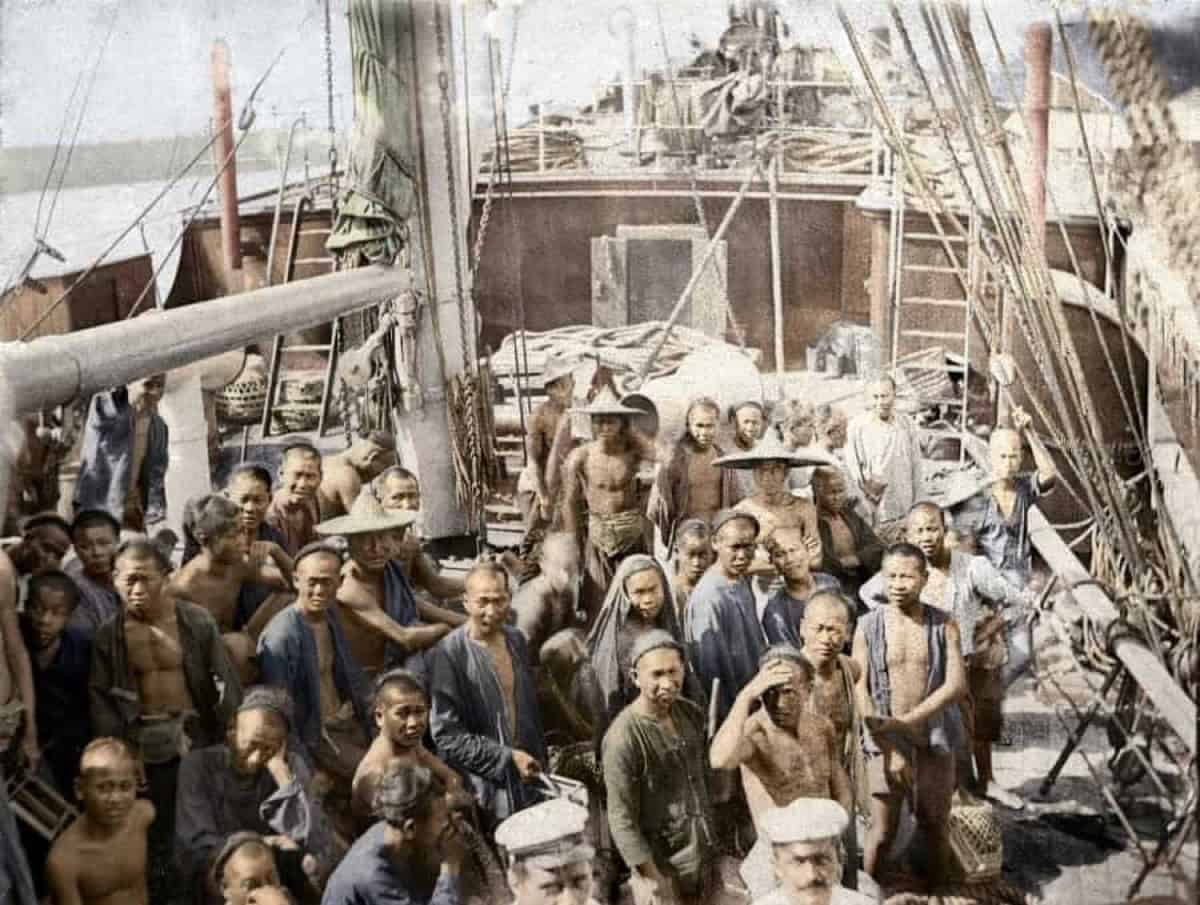
Cuba was the first destination, during the coolie trade era. Enping laborers were among the 125,000 Chinese men — almost all from Guangdong — who arrived in Havana between 1847 and 1874 under eight-year contracts that amounted to near-slavery. They cut sugar cane in the Havana-Matanzas corridor alongside enslaved Africans, living in barracoons (slave quarters) and dying at rates that horrified even contemporary observers. Those who survived their contracts often stayed — opening small businesses, marrying Cuban women, and creating the Chinese-Cuban community that persists today, concentrated in Havana’s Barrio Chino.
n

n
Peru received Enping coolies as well, bound for the guano islands off the coast — a labor assignment so brutal that suicide rates among Chinese workers were among the highest ever recorded for any migrant group in the Americas. The Coolie Trade that fed these routes represented one of the darkest chapters in migration history, and Enping’s inland villages were among its recruiting grounds. The Enping County Gazetteer records village-level data on who went, when, and — in some cases — whether they ever came back.
n
Brazil became a destination in the post-World War II era. An estimated 50,000 to 80,000 people of Enping descent now live in Brazil, concentrated in São Paulo’s Liberdade district — the largest Japanese and Chinese neighborhood in Latin America. The Enping-Brazil community is smaller than the Venezuela one, but more stable, having weathered fewer economic crises. Enping associations in São Paulo maintain ties to home villages, fund school construction, and organize roots-seeking tours.
n
Argentina has a smaller Enping community in Buenos Aires, and a smaller one still now exists in the United States — an estimated 20,000 to 30,000 Enping Americans, mostly in San Francisco and New York, the descendants of the few who made it through before the Exclusion Act or who arrived through family reunification after the 1965 Hart-Celler Act opened US immigration again.
n

n
The Jinshanpo of Enping
n
The Wuyi emigration was overwhelmingly male. For every man who boarded a ship at Macau, a woman stayed behind — a jinshanpo (金山婆), “Gold Mountain wife,” named for the California Gold Mountain that her husband would never reach (he was in Caracas or Havana, not San Francisco, but the term applied regardless). She managed the farm. She raised the children. She received the remittances — when they came — and managed the household accounts through years of separation that often stretched into decades. Like the women of the Wuyi diaspora everywhere, she learned to run a household economy from her kitchen while her husband ran a restaurant in a city she would never see.
n
Enping’s jinshanpo faced the same structural conditions as their Taishan counterparts, with one crucial difference: the remittance transit from Latin America took longer, arrived less predictably, and left a thinner paper trail. A wife in an Enping village waiting for money from Caracas might wait months between letters, riding the fluctuations of oil prices and political stability in a country she would never see. The qiaopi that did arrive often contained more than money — they contained instructions for house construction, school enrollment decisions, and family disputes adjudicated at a distance of 16,000 kilometers.
n
Some of these women became powerful figures in their villages — managing rental properties built with remittance money, brokering marriages, overseeing ancestral rites. The Enping County Gazetteer records cases of women who ran entire village economies from their kitchens while their husbands ran restaurants in Caracas. Their stories are among the least-documented chapters of Chinese diaspora history.
n
A Different Kitchen
n
You can taste Enping’s geography in its food. While Taishan cuisine centers on seafood — steamed fish, oyster omelets, shrimp paste — and Kaiping is known for fermented tofu and claypot rice, Enping’s kitchen draws from the mountains.
n
Hot spring eggs (温泉蛋, wēnquán dàn) are the county’s most famous dish: eggs slow-cooked in the geothermal waters of the Jinjiang springs, emerging with a custard-like texture that can only be achieved at precisely 70 degrees Celsius. Enping rice rolls (恩平肠粉, Ēnpíng chángfěn) are thinner and more delicate than the Cantonese version, often served with mountain herbs and a lighter soy. Game meats — wild boar, mountain pheasant — appear on village tables. Ginger and medicinal herbs, grown in Enping’s hills, season the broth.
n

n
Enping’s cuisine also traveled south. In Caracas, Chinese-Venezuelan restaurants serve a hybrid cuisine that fuses Enping home cooking with Venezuelan ingredients: arepas stuffed with Chinese-style braised pork, fried rice with plantains, wontons in cilantro-lime broth. In São Paulo’s Liberdade, Enping-Brazilian restaurateurs serve pastel (Brazilian fried pastries) filled with char siu. These fusion cuisines are living documents of a migration that is barely recorded on paper.
n
The Wuyi Food Guide notes that Enping’s food culture is the least documented of the five counties — a parallel to its broader diaspora story. The flavors are there. The documentation isn’t.
n
“We’re Not Taishanese”
n
Walk through an Enping village market and you will hear a Siyi dialect that is unmistakably distinct — not Taishanese, not standard Cantonese, not Xinhui dialect. Enping dialect (恩平话, Ēnpíng huà) has different tones, different vowel shifts, and vocabulary items that don’t exist in neighboring counties. A Taishanese speaker and an Enping speaker can make themselves understood with effort, but the differences are substantial enough that Enping identity is linguistically marked.
n

n
“We’re not Taishanese” is a phrase you hear in Enping — not with resentment, but with the quiet insistence of a place that knows it has its own story. It is the identity of the overlooked sibling: proud of what it is, aware that the world knows the other siblings better.
n
The dialect is under threat. Second-generation Enping diaspora in Caracas and São Paulo are far more likely to speak Spanish or Portuguese than their grandparents’ tongue. Third-generation diaspora rarely speak it at all. The language is sustained primarily by elderly speakers in Enping villages — and by the WeChat voice messages that now connect them to relatives abroad, replacing the qiaopi letters of an earlier era.
n
The Venezuela Crisis and Its Aftermath
n
In 2013, Venezuela’s economy began a collapse that would become one of the most severe in modern Latin American history. Hyperinflation, food shortages, and political instability drove millions of Venezuelans abroad. The Enping diaspora was caught in the collapse of the country they had built lives in for a century.
n

n
Some returned to China — a reverse migration that brought elderly Enping-Venezuelans back to villages they had only known through photographs and remittance letters. Others moved sideways: to Brazil, to Argentina, to Spain, to Panama, to the United States, wherever family networks and language skills opened a door. A migration corridor that had funneled people from Enping to Venezuela for a hundred years suddenly reversed.
n
The impact on Enping’s villages was immediate. Remittances from Venezuela — which had sustained rural economies for decades — dried up. The Western-style villas built with oil-boom money became emptier. The “return pensioner” phenomenon emerged: older diaspora members, their savings wiped out, coming home to spend their remaining years in the villages their grandparents left, often living in the houses their own remittances had built decades earlier.
n
At the same time, Enping’s hot spring tourism has offered a new economic base. The same geothermal water that cooks eggs and attracts domestic tourists is now being marketed to diaspora visitors — roots-seeking trips that combine ancestral village visits with spa stays. The roots trip planning guides on this site are designed partly for this emerging demographic: second-and-third-generation diaspora who want to see their ancestral villages and soak in the hot springs their grandparents described.
n
The Corner Finds Its Light
n
Enping is still the quiet county. It does not have Kaiping’s UNESCO diaolou or Taishan’s sprawling Chinatown connections or Xinhui’s chenpi empire. But in the 21st century, the things that made Enping different are becoming its assets.
n
The hot springs — once a local curiosity — are now a tourism engine, attracting visitors from across the Pearl River Delta. The Latin American diaspora connections — once a migration footnote — are now a distinctive identity, unique among Wuyi counties. The cuisine, the dialect, the architecture, the Venezuela story — together they form a coherent narrative that is unlike any other in the Chinese diaspora.
n
The Wuyi Village Atlas maps the geography of a region whose emigrants reshaped communities on four continents. Enping is a full fifth of that map — and for too long, the least explored corner. Its story is the alternate ending to the Wuyi narrative: not the railroad camps of California, but the oil fields of Venezuela; not the Exclusion Act’s paper sons, but the coolie ships to Havana; not chop suey in San Francisco, but hot spring eggs in the shadow of Datianding.
n
For the hundreds of thousands of people of Enping descent scattered across Latin America — and for the diaspora descendants planning their first roots trip — that story has been waiting.
n
Continue Reading
n
- n
- From Haikou Port to the World: 200 Years of Wuyi Diaspora
- Chinese in Cuba: History and Legacy
- Coolie Trade: History and Impact on Chinese Laborers
- Wuyi Village Atlas: A Guide to the Five Counties
n
n
n
n
n
Stay Connected
n
Follow RootsOfChina on Facebook and Instagram for new article updates, behind-the-scenes from Kaiping, and stories from the Chinese diaspora.
n
Sources
n
- n
- 梅伟强、张国雄. 《五邑华侨华人史》. 2001.
- 黄昆章. 《广东台山华侨史》. 2010.
- 刘进. 《银信与五邑侨乡社会》. 2011.
- 袁丁. 《跨国移民与近代广东侨乡》. 2019.
- Hsu, Madeline. Dreaming of Gold, Dreaming of Home: Transnationalism and Migration Between the United States and South China, 1882-1943. Stanford University Press, 2000.
- 王鹤鸣 et al.《岭南姓氏族谱辑录》. 2002.
- 恩平地方志办公室.《恩平县志》.
- UNESCO Memory of the World — Qiaopi and Yinxin Correspondence (2013). https://en.unesco.org/memoryoftheworld
- Kaiping Diaolou and Villages — UNESCO World Heritage (2007). https://whc.unesco.org/en/list/1112
- Jiangmen Wuyi Overseas Chinese Museum (江门五邑华侨华人博物馆). http://www.jmwym.com
n
n
n
n
n
n
n
n
n
n
n
Did your family come from Enping or one of the Wuyi counties? Every family has a story — the village they left, the journey they took, the name they carried. If this article stirred something, share your family’s story here — we read every one, and your story may help another reader find theirs.
nn
Never Miss a Story
n
Join fellow descendants uncovering their Wuyi roots — get our weekly digest of new stories, surname guides, and roots-trip tips.
n
nn
Suggested Reading
Is this your family’s story?
Roots Of China is built from readers’ family histories. If a story here sounds like your own — a surname, a village, a journey — leave a comment below, or share your family’s story with us and we may be able to help you find your ancestral village.
