


The Su (苏) Surname: From the Ancient State of Su to the Wuyi Diaspora
A State Gives Its Name (苏国)
The Su (苏, Sū) surname traces its origins to the ancient State of Su, a Zhou-era vassal state in what is today Wen County, Henan — and from that small principality a lineage that produced Su Wu, the Han dynasty envoy who herded sheep for nineteen years rather than submit, and the Three Sus of the Song dynasty, including the poet Su Shi, carried the name south through the Pearl River corridor into the villages of the Wuyi and out across the Pacific with the Gold Mountain migrations.
Roughly seven million people carry the surname today — sources place it anywhere from 37th to 46th among Chinese surnames, with roughly 41st the figure most often cited — and Guangdong is its most populous province, home to about a fifth of all Sus. The origin narrative (受姓源流, shòuxìng yuánliú) begins with a minister, not a warrior.
According to Wen County’s local history, the first Su-surnamed person in the historical record is 苏忿生 (Su Fensheng), chief judicial officer (大司寇, dà sīkòu) under King Wu of Zhou, enfeoffed with twelve townships in the Henei region (河内), Wen as his seat. His state lasted roughly four centuries before the Di peoples destroyed Wen in 650 BCE. The survivors took the state’s name as their own surname — 以国为氏 (yǐ guó wéi shì) — which is why the Wen surname (温) shares this origin with Su. The lineage (苏氏, Sūshì) claims descent from Zhurong (祝融) through Kunwu (昆吾); that claim is a family’s self-understanding, distinct from the textual record.
Clan genealogies and modern scholarship differ on details — some place the original fief in neighboring Bo’ai County — and the material traces are modest: a 2003 stele at Zhaoxiang Township marks the ruined capital (温国故城遗址). Memory and history both get a voice, each with its honest label.

Wen County, Henan — the ruined capital of the ancient State of Su at Zhaoxiang Township (温县温国故城遗址).
The Famous Name: Su Wu and the Three Sus
Every Chinese speaker knows the name Su before they know any Su person.
苏武 (Su Wu, c. 140–60 BCE) was the Han envoy sent to the Xiongnu in 100 BCE. Held captive for nineteen years, he refused to submit, herding sheep on the northern shore of Lake Baikal (北海) rather than bend. The whole story compresses into one object: the envoy’s staff (节, jié) he carried all those years, its tassels long gone — when he finally returned in 81 BCE it was a bare wooden stub. Honored among the Eleven Worthies of the Qilin Pavilion, he became the scene of 苏武牧羊 (Su Wu herding sheep), one of the great loyalty narratives in Chinese culture.
That stub made him the surname’s moral exemplar. 武功 (Wugong, Shaanxi) is the surname’s primary 郡望 (jùnwàng), stamped into clan halls worldwide, and 武功堂 (Wugong Hall) its leading hall name. A couplet at his memorial in Wugong County reads, “Nineteen years braving frost and snow… thousands of li, returning from the barbarians to Han.”
The roll-call runs long — 苏秦 (Su Qin), the Warring States strategist, deserves exactly one line — but the summit is the 三苏 (Sān Sū, the Three Sus): 苏洵 (Su Xun, 1009–1066), 苏轼 (Su Shi, 1037–1101), and 苏辙 (Su Zhe, 1039–1112) of 眉山 (Meishan, Sichuan), three of the 唐宋八大家 (Eight Great Prose Masters of the Tang and Song). Their Meishan line traces to the Tang chancellor 苏味道 (Su Weidao), exiled to Sichuan as prefect of Meizhou — the same line, a millennium on, that a Wuyi battle would bring home again.
The fame is wired into lineage architecture. A Su clan hall in the Zhujixiang corridor hangs the couplet that pairs the surname’s two pillars — Su Wu and Su Shi in one pair of lines. The family precepts (家训, jiāxùn) recited at Meishan’s shrine run: “Study and honest work; filial kindness and love; never take what is unjust; govern with clean hands.” And the surname shaped how all Chinese families kept records: Su Xun’s genealogy method (苏式谱法, Sūshì pǔfǎ) became one of the two national standards — the 欧苏谱例 (Ou–Su models) — a gift that doubles as a research tool. Even everyday recognition works this way: 苏东坡 (Su Dongpo), the name the poet gave himself in exile, sits on menus everywhere as 东坡肉.

Su Wu herding sheep — the Han envoy and his worn staff (苏武牧羊).

The Three Sus of Meishan — the surname’s literary summit (三苏祠, 眉山).
珠玑巷: The Corridor South
The surname’s geography is a map of Chinese history itself: out of the Central Plains to Wugong in Shaanxi, down to Meishan in Sichuan, then south into Lingnan — Guangdong — and at last overseas.
For most Cantonese lineages, the hinge of that southward journey is 珠玑巷 (Zhūjī Xiàng, Zhujixiang), a lane in 南雄 (Nanxiong) that grew into the great staging post of migration into the Pearl River Delta. The story as told for Su: a Su clan hall was rebuilt there in 1994, the first of more than a hundred surname halls completed in the corridor, its couplets running “Martial merit endures a thousand years from Dulin; achievement passes ten thousand generations remembering Zhujixiang” and “Younger brother of a loyal minister of Han; household of a Song scholar.” Inside, a portrait of the claimed ancestor Kunwu is enshrined.
The honest register matters here, as for every surname in this series: the corridor legend is well documented for Guangdong surnames in general, but the Su-specific telling — which generation, which ancestor, which year — survives mainly in clan records, and should be read as clan memory rather than settled chronology.
There was a second door into Guangdong: the Fujian coastal route, through Su Yi (苏益), the ancestor who led the surname into Fujian (入闽), and his Lushan branch (芦山衍派) — an identity marker that matters later, when overseas Su communities split between the Wugong line and the Lushan line.
And there is the invisible thread: the generation-poem system (字辈, zìbèi, also 派语, pàiyǔ), by which branches assigned children’s middle characters generation by generation, keeping even far-flung overseas branches synchronized with the trunk lineage. No Wuyi Su generation poem has been documented, so this article describes the system rather than quoting one — but the system itself is how a Su in Vancouver and a Su in Taishan could once tell, from two names, where each stood in the same line.

The memorial corridor at Zhujixiang, Nanxiong — the great staging post of migration south (南雄珠玑巷).
Wuyi Settlement: The Honest Geography
In the five counties of Guangdong — the Wuyi region (五邑, Wǔyì): Taishan (台山), Xinhui (新会), Kaiping, Enping, and Heshan — Su is a mid-size clan, 22nd among 156 surnames in one Taishan compilation, present but not marquee.
Here the evidence demands honesty. The book literature on the Taishan overseas Chinese places Su concentrations in Duanfen (端芬) and Baisha (白沙), but no named Su village in Taishan has surfaced in any web-accessible source; the county’s online surname index carries no Su entry; and Haikoubu, the celebrated first port of Cantonese emigration, was founded by ten surname groups (梅、黎、吴、李、关、阮、黄、江、陈、何) — with Su not among them. The book-level claims may well be right; they are simply not repeated here as verified fact, and no village name is invented.
What is verified is stranger and more moving: the Wuyi root of the most famous name in the family. Xinhui county records, in the register of immovable cultural relics, list 苏刘义 (Su Liuyi, 1232–1279), courtesy name Renzhong, style name Fuhan — a descendant of Su Shi in the eighth generation, through the line of Su Shi’s son Su Mai — who served the last Song court as commander of the palace guard (殿前都指挥使). When the Mongol armies closed in, Su Liuyi escorted the boy-emperor’s court to Xinhui’s 崖门 (Yamen), established the court-in-exile at Yashan, and died in the naval battle of 1279 that ended the Song dynasty — the Battle of Yamen (崖山海战, Yáshān hǎizhàn). He was buried west of the Yamen sea.

Yamen, Xinhui — the sea-battle site where the Song dynasty ended in 1279, and where a descendant of Su Shi fell (崖山海战).
The dynasty that produced Su Shi ended in that battle, and with it fell one of his own descendants. What survived was the son: 苏景由 (Su Jingyou), Su Liuyi’s second son and Su Shi’s ninth-generation descendant, who fled into Xinhui and lived out his life in seclusion at Shayong (沙涌) — ancestor of the Xinhui and Zhongshan Su branches, the seed of the local clan (房, fáng) planted in Wuyi soil. In Zhongshan’s ancient Guyi village, the Su ancestral hall (苏氏宗祠, Sūshì zōngcí) built in the Ming Zhengde era (1506–1521) carries the couplet: “Ancestral virtue flows a thousand years; Wugong’s favor endures ten thousand.”
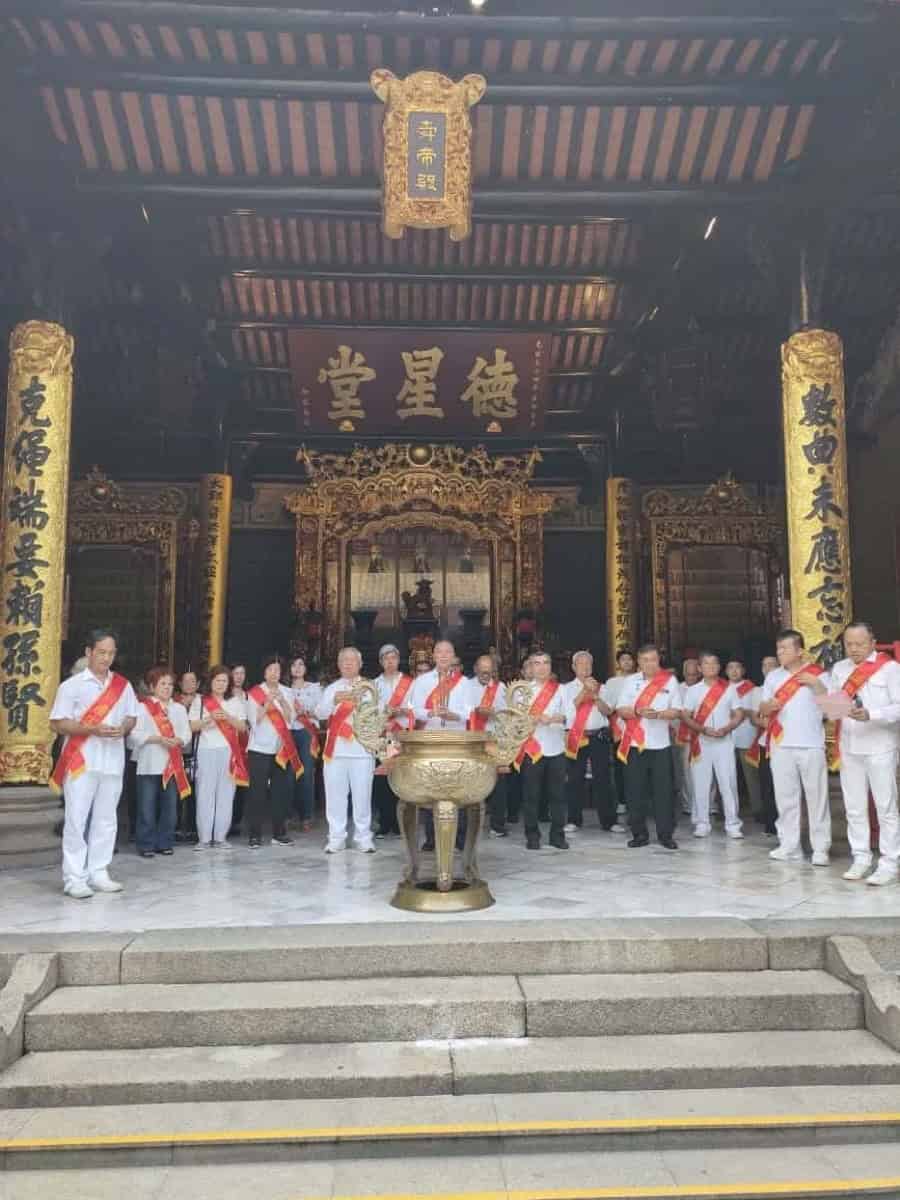
A Su ancestral hall in the Wuyi tradition — carved pillars and ancestor tablets (苏氏宗祠).
For a descendant planning a roots trip, the anchors are Duanfen town’s eleven overseas-Chinese market towns (侨圩), Haikoubu’s museum, and Xinhui’s Yamen, where relics of the last Song court remain. A Su traveler stands where the most famous bearer’s own blood once fought — the Wuyi root of a textbook-famous name.
Gold Mountain: The Surname as a Migration Vehicle
The sea crossing was a Su family habit long before the Gold Mountain. Su Shi himself crossed water into exile — Huizhou in 1094, then, at sixty-one, across the strait to Danzhou in 1097, where he taught and trained the island’s first juren scholar. No line runs from that exile to the credit-ticket ships; the resonance is this article’s framing, not causation.
The ships came after the 1840s, when the aftermath of the Opium Wars — economic collapse, natural disaster, the Punti–Hakka feuds (土客械斗), and the fraud of the “piglet” contract-labor trade (猪仔) — pushed Cantonese farmers toward the coast. Taishan people sailed from Guanghai and Haikoubu, ports whose story is told in Wuyi migration’s hidden ports, toward 金山 (Gold Mountain), the Cantonese name for America.
The migration ran on surnames. County historians describe the pattern: one village one surname, several villages one surname, families clustered and settled by lineage — with surname-specific destinations. The Mei of Duanfen went to Chicago and New York; the Ma of Baisha to Edmonton and Calgary. No Su-specific destination chain has yet been documented, but the mechanism was built for names, and the Su name traveled on the same tracks.
Crossing was financed by 赊单制 (shēdān zhì), the credit-ticket system: passage advanced against future wages, repaid from laundry and restaurant work, railroad labor, and market gardening. The men who made it became 金山客 (jīnshānkè), Gold Mountain sojourners — figures of awe and suspicion back home, rebuilding clan halls and endowing village schools with their remittances. The villages learned to measure a man by whether he had crossed the sea.
The diaspora split into two geographies — the Americas, where sojourners dreamed of gold and return, and 南洋 (Nányáng, the South Seas), Southeast Asia, where Su families built deeper and longer-lived communities.
Exclusion and Paper Sons
In 1882 the United States passed the Chinese Exclusion Act, the first law in American history to bar immigration by race; Wuyi migration, already the largest in the Chinese world, adapted. Head taxes, certificates, and interrogations replaced open doors.
The system produced its own machinery of kinship. Paper sons (纸儿子, zhǐ érzi) bought fabricated identities — a slot in a documented family, a village, a surname — and memorized their invented lives before the interrogation room on Angel Island, where officials asked how many brothers a candidate had, what his father’s nickname was, which hall stood next to his.
The paradox: exclusion was meant to break the networks, and it made them load-bearing. A paper son needed a real surname story to survive — real village geography, real generational names, real clan connections — so the clan and surname organizations that certified new arrivals became more essential, not less. The associations that met ships and vouched for newcomers are the direct ancestors of the clan halls described later in this article.
And exclusion rerouted the diaspora. Canada, Cuba, Peru, and other Latin American countries took workers the United States refused; Southeast Asia and Australia absorbed more. The surname became a map of the Pacific — even as the region that produced the migrants was convulsed in the arc that would end the Qing dynasty. No Su-specific paper-son record has surfaced in any archive catalog consulted; the documented cases are county-level, from Taishan and its neighbors. The mechanism, and its cost, belong to the whole region’s story — years of waiting, a name not quite yours, silence kept even from neighbors.
Qiaopi and Yinxin: Money Plus Message
The split household ran on a single document: the 银信 (yínxìn, “silver letter”) — a remittance and a family letter in one envelope, known across Guangdong as 侨批 (qiáopī). The money paid for the farm, the children’s schooling, the ancestral rites; the message carried the longing, the guilt, the instructions.
Couriers called 批馆 (pīguǎn) moved the letters along clan routes from Gold Mountain cities to county towns to villages. The Wuyi region preserves the largest archive of them anywhere — roughly fifty thousand items across Jiangmen and the five counties, with the earliest known Wuyi silver letter dated 1875 — and in 2013 the qiaopi archives were inscribed in UNESCO’s Memory of the World register. Haikoubu’s Silver Letter Museum and its twenty commemorative pillars stand on the very port the letters left from — part of the wider Wuyi migration heritage preserved in the region’s museums.
Researchers of the archives describe a consistent three-register structure: the accounting — how much was sent, through which agency, split among parents, children’s tuition, hall rebuilding, village schools; the message — love for a wife managing alone, grief for a parent’s funeral missed, guilt for years of absence; and instruction, household management directed from across an ocean. Some letters carried no money at all: the 空批 (kōngpī, “empty remittance”), the message and the accounting with the cash line unfilled, a way of saying the money would come, or had gone elsewhere. The clan magazines (侨刊, qiáokān) kept the overseas-Chinese (华侨, huáqiáo) community legible to itself, and Reading Qiaopi explains what these letters reveal about Wuyi families.
This is the article’s honest gap: no Su-surnamed silver letter has surfaced in any web-accessible museum catalog. The archives are vast, and a museum query at the Wuyi Overseas Chinese Museum or the Taishan Silver Letter Museum may yet find one. Until then, the letter described here is the pattern a Su great-grandfather’s letter would have followed, drawn from the county-level record: a father instructing a wife he had not seen in years about a child he had never met — the whole economic-and-emotional machinery of the split household in a few lines.
That single artifact rebuilt the villages. Overseas-style houses rose along Taishan lanes; in towns like Baisha the fortified watchtowers (碉楼, diāolóu) still punctuate the landscape; halls were rebuilt and schools endowed. The money that built them and the sentences that ached in them were the same paper — the village life of the Wuyi region written, in a real sense, by these letters.

A silver letter — remittance and family letter in one envelope, from the Wuyi museum collections (银信/侨批).
The 金山婆: The Women Who Ran the Villages
The silver letters were addressed, more often than not, to a woman: the 金山婆 (jīnshānpó), the Gold Mountain wife who ran the household alone for decades.
The marriage pattern the emigrants left behind — the 牛郎织女 (Niúláng Zhīnǚ) marriage, named for the mythic lovers separated across the Milky Way — produced villages of wives and children, fathers appearing once a decade or not at all. The Gold Mountain wife managed the farmland, raised the children, kept the lineage property, and performed the ancestral rites: work the village understood as a woman’s duty, which is not quite the same as honoring it.
The double register must be held together. The cost: decades alone, children growing up strangers to their fathers, uncertainty whether the man would return or the money keep coming. The agency: women who ran households, corresponded across oceans, and held lineages together through war and revolution — an authority the villages had rarely granted before. Where wives could not read, the silver letter was read aloud at the village gate, its contents weighed by neighbors; women who learned to write their replies entered a literacy economy their mothers never had.
The photographs complicate the story: studio portraits sent home from San Francisco or Vancouver — a man in a suit standing stiff beside a chair that held no wife. Faces the Gold Mountain wife and her children knew from a single print, hung on the wall, studied for years.
And the return, when it came, redrew the village’s pecking order: the sojourner who had crossed the sea outranked the scholar who had not, and the returned overseas Chinese (归侨, guīqiáo) reshaped lineage hierarchy around the new geography of status.
No Su-specific Gold Mountain wife is documented in any source consulted; this register is built from the county-level record of Taishan and Xinhui, and no invented name is attached to it. The pattern is the point: a Su wife in a Taishan village lived this, because thousands of wives of every surname did — their lives are mapped in Women of Wuyi: Jinshanpo, Amahs, and the Ones Who Left.

An archival photograph of a qiaoxiang woman — the Gold Mountain wife who ran the village alone (金山婆).
The Halls: 苏氏 at Home and Abroad
In the Chinatowns of the diaspora, associational life ran on surnames before counties. A newcomer arrived knowing his 姓 — his surname — and the surname association was the first door: mutual aid, credit and burial circles, remittance forwarding, schools, a bed and a job. The linguistic bond was the dialect — 台山话 (Taishanese) and Cantonese — and halls that sheltered a new arrival in 1870 raised money for the 1911 Revolution and later the war against Japan. The Guan clan’s story in Xinhui shows how far one surname’s institutions reached, and the clan and brotherhood world is mapped elsewhere in this series.
For the Su surname, the strongest documented institutional record is in Southeast Asia.
In Medan, Indonesia, the 苏北苏氏宗亲会 (North Sumatra Su Clan Association) holds autumn rites (秋祭) that Chinese consulate officials have attended in person — in 2019 and again in 2023, when the consul general came to award scholarships to outstanding students of Chinese. Its chairman, 苏用发 (Su Yongfa), industrialist and fifth president of the World Su Clan Association, funded the compilation of the 《新编苏氏总族谱》 (New Comprehensive Su Genealogy, 族谱 zúpǔ): twenty-six volumes published 2006–2012, described as the most complete Su genealogy in the world, with copies donated to archives including Hunan’s Chaling County Archives.
The world body itself grew from the diaspora: founded in 1938 by overseas Su in the Philippines as the Nanyang Wugong Su Clan Association, reorganized as the 世苏总会 (World Su Clan Association) in 1993, and formally established in Manila in 1994, with its Wugong Building on Nala Street. Its biennial congresses have met in Singapore, Xiamen, Bali — and, in 2012, on a cruise ship. In 2008, more than eight hundred delegates gathered in Wugong County itself for the seventh world gathering.
The Fujian-derived line runs parallel. The 芦山堂 (Lúshān Táng, Lushan Hall) in Tong’an, Xiamen — shrine to the founding ancestor Su Yi and home of the Song polymath 苏颂 (Su Song, 1020–1101) — was rebuilt in 1988 with overseas donations; it now hosts an annual Su Song Culture Festival in its twelfth edition. Singapore’s Su Clan Association traces to a Lushan office founded in 1929. And in 2026, in Chaozhou’s Helong village, the ancestral house of a Thai-Chinese Su family was converted into a clan hall, a “home for overseas compatriots” — diaspora philanthropy returning as lineage prestige, the same return-and-rebuild pattern the Cao surname’s Wuyi diaspora story documents from another angle.
North America is treated with the same honesty: the State Council’s 2009 census of San Francisco Chinatown associations lists no Su hall; a single clan-network summary mentions a 旅美苏氏宗亲会 in San Francisco, with no founding date or hall; Vancouver and New York show nothing in any source consulted. The model above is how Su families would have organized, and the World Su network has drawn American delegates to its gatherings — but no major Su hall in an American Chinatown is claimed here, because none is documented. The association halls (会馆, huìguǎn), family rules (家规, jiāguī), and charters that would name such a hall remain a research question rather than a fact.

A Nanyang Su clan hall — autumn rites of the North Sumatra Su Clan Association, Medan (苏北苏氏宗亲会秋祭).
The Name Endures
For a descendant starting out, the first obstacle is also the first key: romanization. The same character 苏 was written Su in Mandarin, So in Cantonese, Sou in Taishanese, Soh or Soo in Hokkien and Teochew, and Sue in older American records — so a great-grandfather filed under “Sue” in a 1910 census and under “So” in a 1930 one is the same man, and the trail only opens if you search every spelling.
The surname’s revival has been spectacular. In 2011, 180-plus Su descendants in thirty-one delegations from six countries gathered at Wugong for the spring rite to Su Wu, with some seven thousand attendees and 1.34 million yuan raised. In 2017, more than a hundred descendants from home and abroad held a worship gathering (祭祖, jìzǔ) at Wen County’s Su Garden. In 2025, three hundred Su descendants assembled at Meishan’s Three Sus Shrine to launch the renewal of the Meishan Su master genealogy — marking the 1,320th anniversary of Su Weidao’s appointment to Meizhou and the 1,016th of Su Xun’s birth. FamilySearch holds an 1825 Su genealogy listing Su Weidao as founding ancestor, Su Xun as celebrated ancestor, and Su Shi as ancestral patriarch, and roots-seeking (寻根, xúngēn) has become a movement with a calendar.
The personal register closes where the documentation is strongest: Brazil. 苏均亮 (Su Junliang), a Taishanese, founded the 巴西广东同乡总会 (Brazil Guangdong Association), the largest Guangdong umbrella in Brazil, representing some 150,000 Guangdong compatriots. He married 伍香琴 (Wu Xiangqin) in São Paulo in 1965, and in 2025 some two hundred guests — including Chinese consulate officials — celebrated their diamond wedding. His words at the banquet, reported by China News: “Taishan is my root. Now that I have five generations under one roof, my descendants must remember: do not forget your roots.” His son Su Jianqiao and granddaughter Su Enci spoke at the same table — three documented generations of the name enduring — and his philanthropy reached his home village of Shige and disaster relief in China. It must be said plainly: this is a Taishan-county association, not a Su-surname hall — but the name it was built around is the name this article follows. The current president, 苏新效 (Su Xinxiao), also Taishanese, represented the association at the 2023 World Conference of Overseas Chinese Associations in Beijing.
The steps for a Roots Seeker are concrete: search romanization variants in census and immigration records; contact a Su clan association or the World Su network; consult digitized genealogies; read a silver letter at the Wuyi Overseas Chinese Museum; join a DNA surname project. The surname’s own tools — Su Xun’s genealogy method, the generation poems, the hall couplets — were built to be found: the Your Surname is Your Compass hub shows how the trail runs from a name to a village, and the journey from surname to ancestral village begins, as with the Wong surname’s arc, with the character on a grandfather’s gravestone.
A name born of a Zhou vassal state now meets, across an ocean, in a São Paulo banquet hall and a Medan autumn rite. The staff Su Wu carried for nineteen years was worn to a bare stub by the time he came home; the name he carried has not worn thin yet.

Contemporary roots-seeking — descendants at a Su ancestral rite (祭祖/寻根), Wugong or Meishan.
Continue Reading
- The Tan (谭) Surname: From an Ancient State of Shandong to the Wuyi Diaspora
- The Yu (余) Surname: From Shaoguan Statesmen to the Wuyi Diaspora
- Lee Surname Wuyi Diaspora: A Thousand Years from Longxi to Gold Mountain
- Your Surname is Your Compass: How to Trace Your Wuyi Roots Starting With Just a Family Name
- From Surname to Ancestral Village: A Roots Trip Blueprint for Wuyi Descendants
Stay Connected
Follow RootsOfChina on Facebook and Instagram for new article updates, behind-the-scenes from Kaiping, and stories from the Chinese diaspora.
Sources
Books
- Madeline Y. Hsu, Dreaming of Gold, Dreaming of Home (Stanford University Press, 2000).
- 刘进, 《银信与五邑侨乡社会》 (广东人民出版社, 2011).
- 张应龙, 《广东台山华侨史》 (广东人民出版社, 2010).
- 苏振武, 《武功苏氏宗谱考》 (陕西人民出版社, 2024).
Web sources
- Wen County Government, Henan — Su Fensheng and the ancient State of Su; the 2017 gathering at Wen County’s Su Garden.
- Henan Provincial Committee of the CPPCC — “焦作温县:苏姓发源地” (2023).
- Xinhui District Government — the register of immovable cultural relics listing 苏刘义.
- Shaanxi Provincial Local Chronicles — the spring rites to Su Wu at Wugong (2011–2012).
- Consulate-General of China in Medan — the autumn rites of the North Sumatra Su Clan Association (2019, 2023).
- Jiangmen Municipal Government — Wuyi silver-letter heritage and the 银信 exhibitions.
- China News — 苏均亮, 苏新效, and the Brazil Guangdong Association.
- State Council Overseas Chinese Affairs Office — “纵观旧金山华人社团发展” (2009), the San Francisco association census without Su.
- Hunan Provincial Archives — the donation of the 26-volume 《新编苏氏总族谱》.
- Chao’an District Government — the 2026 Helong village Su clan hall.
- UNESCO Memory of the World — Qiaopi and Yinxin Correspondence — the 2013 inscription of the qiaopi archives.
- U.S. National Archives — Chinese Americans and the Chinese Exclusion Act — the exclusion-era records behind the paper-son system.
- Angel Island Immigration Station Foundation — the station where paper-son interrogations were conducted, 1910–1940.
- FamilySearch Catalog — 《苏氏族谱》 (1825).
Suggested Reading
Is this your family’s story?
Roots Of China is built from readers’ family histories. If a story here sounds like your own — a surname, a village, a journey — leave a comment below, or share your family’s story with us and we may be able to help you find your ancestral village.
