


Wuyi Roots Trip Itinerary: A 10-Day Plan for Descendants
\n
The Wuyi region of Guangdong sent over two million people overseas between 1840 and 1940 \— and every year, thousands of their descendants come back looking for the villages their families left.
\n
That number inverts almost everything you expect from a place. The Five Counties \— Wuyi (\五\邑, W\ǔy\ì): Taishan (\台\山, T\áish\ān), Kaiping (\开\平, K\āip\íng), Enping (\恩\平, \Ēnp\íng), Heshan (\鹤\山, H\èsh\ān), and Xinhui (\新\会, X\īnhu\ì) \— are home to more of their descendants abroad than at home: Taishan alone counts roughly 1.6 million across 107 countries, more than its resident population. This inversion defines the qiaoxiang (\侨\乡, qi\áoxi\āng \— overseas-Chinese homeland) and makes the region the archetype of South China emigration \— villages built on remittances, schools funded by laundrymen in San Francisco, a railway laid by sons who never came home.
\n
Every year, thousands of descendants do come back. The ones who search hardest arrive with a county name, a surname, and a stack of questions. This itinerary is for them: ten days out of and back to Jiangmen (\江\门, Ji\āngm\én), through five county chapters in an order that minimizes backtracking. Each day is a scannable unit \— base town, morning, afternoon, evening, transfers, meals, sleep, costs \— with room built in for the moments a schedule can’t predict. A roots trip reenacts luoye guigen (\落\叶\归\根, lu\òy\è gu\īg\ēn \— “falling leaves return to the roots”), the moral completion of migration, yet it must be planned like any trip. That tension \— the schedule versus the sacred \— is the design problem here, and this plan solves it by protecting the emotional core: the letters, the towers, the graves, and the people who hold the keys.
\n
If you know your family’s county of origin, this plan is already half-personalized \— and our practitioner’s guide to finding your Chinese ancestral village walks through the full method \— the surname-to-village method and the roots-trip compass can pin down the village before you book. The route works for everyone; the county swaps are marked where they matter.
\n
Before Day One: The Research Pack and the Calendar
\n
The ten days will find as much as you prepare for. Before booking flights, do three things:
\n
Build your research pack. The Village Atlas of Wuyi maps the qiaoxiang villages this route visits, village by village. If your family’s village publishes a qiaokan (\侨\刊, qi\áok\ān \— village newsletter, some more than a century old), read it before you go; many still carry news of returnees and ancestral-hall repairs. Contact the county qiaolian or qiaoban (\侨\联/\侨\办, qi\áoli\án/qi\áob\àn \— the Overseas Chinese Federation and Affairs Office), your first practical contact and the official reception host for returning families; county phone numbers are not reliably published online, so reach them via government websites. For archival depth, request access ahead of time: the Jiangmen Municipal Archives (\江\门\市\档\案\馆) runs a digital genealogy platform for roots-searching, and Wuyi University’s Guangdong Qiaoxiang Culture Research Center (\五\邑\大\学 \广\东\侨\乡\文\化\研\究\中\心) has processed 6,000+ yinxin and digitized 3,000+ \— office 0750-3299241. And if your family holds a house in the village, get a qiaofang zhengce (\侨\房\政\策, qi\áof\áng zh\èngc\è) ownership briefing \— the policy governing who may enter, repair, and reclaim ancestral homes; Jiangmen runs an offshore legal-services and remote-notary network for overseas owners. That one briefing can change your village day.
\n
Fix your dates around the calendar, not the calendar around your dates. Taishan’s grave-visiting season, baishan or xingshan (\拜\山/\行\山, b\àish\ān \— “visiting the mountain”), runs from the second day of the second lunar month through Qingming (\清\明), which draws the year’s largest return wave. The biennial World Taishan Ningyang Clan Association Convention (\世\界\台\山\宁\阳\会\馆\联\谊\大\会) brought more than 1,000 overseas xiangqin (\乡\亲, xi\āngq\īn \— fellow townspeople) home in November 2025; the next edition is expected around 2027, and autumn kinship conventions (\恳\亲\大\会, k\ěnq\īn d\àhu\ì) cluster in November. Summer roots-seeking camps for young descendants \— the qiaolian’s “China Roots-Seeking Journey” (\寻\根\之\旅, x\úng\ēn zh\ī l\ǚ) \— run this same circuit. If ancestral rites matter to your family, schedule around them.
\n
Check the museum calendar. Region-wide, museums close Mondays, and the Taishan Yinxin Museum closes midday \— a Monday arrival reshuffles the first three days. The visa and route guide covers arrival: Jiangmen is 30\–38 minutes by HSR from Guangzhou South.
\n
The Circuit: One Region, Five Chapters
\n
The route is a loop: Jiangmen \→ Taishan \→ Kaiping \→ Enping \→ Heshan/Xinhui \→ Jiangmen. What makes it practical is the rail spine. The Jiangzhan Railway (\江\湛\铁\路), opened in 2018, links Jiangmen, Taishan, Kaiping South, and Enping stations with high-speed legs of 20\–60 minutes between county base towns \— Jiangmen to Taishan about 20, Taishan to Kaiping South about 10, Kaiping South to Enping about 19 (live schedules vary; check 12306 at booking). The 2025 Taishan\–Kaiping expressway adds a 30-minute driving corridor between the two county seats. Base towns anchor each leg: Taicheng (\台\城, T\áich\éng) for Taishan, Sanbu (\三\埠, S\ānb\ù) and Tangkou (\塘\口, T\ángk\ǒu) for Kaiping, Encheng (\恩\城, \Ēnch\éng) for Enping, Huicheng (\会\城, Hu\ìch\éng) for Xinhui.
\n

\n
Every day below follows one template: base town, morning/afternoon/evening blocks, key sites with one line of historical framing, transfers, meals, sleep, budget pointer, and a rites or reception window where it applies. Meals and lodging live in the Wuyi food guide and the accommodation guide; costs are handled in the budgeting guide, which we link rather than re-figure.
\n
One region, five narratives: Taishan points to North America, Kaiping to Canada and the United States, Enping to Latin America, Heshan and Xinhui to Southeast Asia. Know your county, and the route stays the same \— the emphasis moves (Section 15).
\n
Day 1 \— Jiangmen: The Museum That Explains You
\n
Base: Jiangmen (Pengjiang district). Beat: the first “I’m really here” moment.
\n
Morning: Arrive at Jiangmen Station (30\–38 minutes from Guangzhou South), check in, settle. The anxiety before a roots trip is legitimate \— you are about to walk into a story you’ve only heard. Name it now.
\n
Midday\–afternoon: The Wuyi Overseas Chinese Museum (\五\邑\华\侨\华\人\博\物\馆) is the master-narrative primer: free, Tuesday to Sunday 9:00\–17:00 (last entry 16:00, closed Mondays \— verify against your arrival day). Its 39,000-plus artifacts include remittance letters and the overseas passports that carried Wuyi people across borders \— stand before the passport cases a moment. Jiangmen calls itself “the capital of overseas Chinese” (\中\国\侨\都), and this museum is the argument for it. Note the yinxin hall; you’ll go deep there on Day 3.
\n
Evening: The riverside qilou (\骑\楼, q\íl\óu \— arcaded street buildings) at dusk, then your first meal \— this is eel-rice country (food guide).
\n
Sleep: Jiangmen city center \— accommodation. Budget: museum free, evening cheap \— budgeting. Rites/reception: none scheduled; re-read your village’s qiaokan and rehearse the qiaolian call. Tomorrow the search begins.
\n
Day 2 \— Taishan, Departure Ports: Where the Letters Began
\n
Base: Taicheng. Beat: recognition \— “this is where my family’s letters began.”
\n
Morning: HSR from Jiangmen to Taishan, about 20 minutes, then out to Haikoubu (\海\口\埠, H\ǎik\ǒub\ù), the departure port in Duanfen township (\端\芬\镇, Du\ānf\ēn) \— a transit point for the exodus, and home to the Taishan Yinxin Museum (\台\山\银\信\博\物\馆): free, Tuesday to Sunday 9:30\–12:00 and 14:00\–17:30 with a midday break, so take the morning slot. Duanfen township alone counts more than 120,000 overseas Chinese and Hong Kong/Macau compatriots \— more people abroad than at home. The museum’s six halls tell the story of the yinxin (\银\信, y\ínx\ìn \— remittance letters, letter and money in one envelope), the lifeline that built these villages.
\n
\n
Afternoon: Three kilometers away, Mei Family Mansion (\梅\家\大\院) \— the Tingjiang market town (\汀\江\圩, T\īngji\āng x\ū) built by overseas families, roughly a hundred shops, free to wander, filmed in Let the Bullets Fly, restored in 2023 with its patina kept. Nearby, Fuyue Village’s villas (\洋\楼, y\ángl\óu) and Miao Bian School (\庙\边\学\校), built in 1928 with donations from overseas Chinese in America \— your first real village visit, and a first lesson in how remittances became buildings.
\n

\n
Reception box \— read before the village welcomes you. When a returning family arrives, the qiaolian and village committee run a script: welcome, tour, banquet, honors. The gift economy of renqing (\人\情, r\énq\íng \— reciprocal obligation) means you will be hosted generously and expected, gently, to reciprocate \— and committees treat donors, family members, and casual visitors differently. Bring small gifts, accept the hospitality, do not overpromise. Some returnees find the special treatment awkward; that is part of the choreography.
\n
Evening: Back to Taicheng, qilou streets and the night market. Transfers: HSR plus taxi or Didi for the Haikoubu\–Mei Family Mansion\–Fuyue cluster \— buses are sparse, so a car is recommended. Sleep: Taicheng \— accommodation. Budget: museums free, taxi legs small \— budgeting.
\n
Day 3 \— The Qiaopi Day: Letters, Money, and the Space Between
\n
Base: Taicheng. Beat: the emotional core of the trip \— family separation made visible. Heaviest museum day, so the afternoon is buffer by design.
\n
Morning: The Taishan Overseas Chinese Culture Museum (\台\山\市\华\侨\文\化\博\物\馆): free, Tuesday to Sunday 8:30\–17:30 (last entry 17:00, closed Mondays), six stories on Taishan’s overseas history with deep qiaopi (\侨\批, qi\áop\ī \— remittance letters) holdings. Here the abstraction becomes concrete: letters that carried both words and silver, written by people who would not see home for decades \— or ever.
\n

\n

\n
Midday: Walk Taicheng’s market-town streets and look for the jinshanxiang (\金\山\箱, j\īnsh\ānxi\āng \— “Gold Mountain trunk”), the great wooden trunk returnees carried home \— the return made into an object.
\n
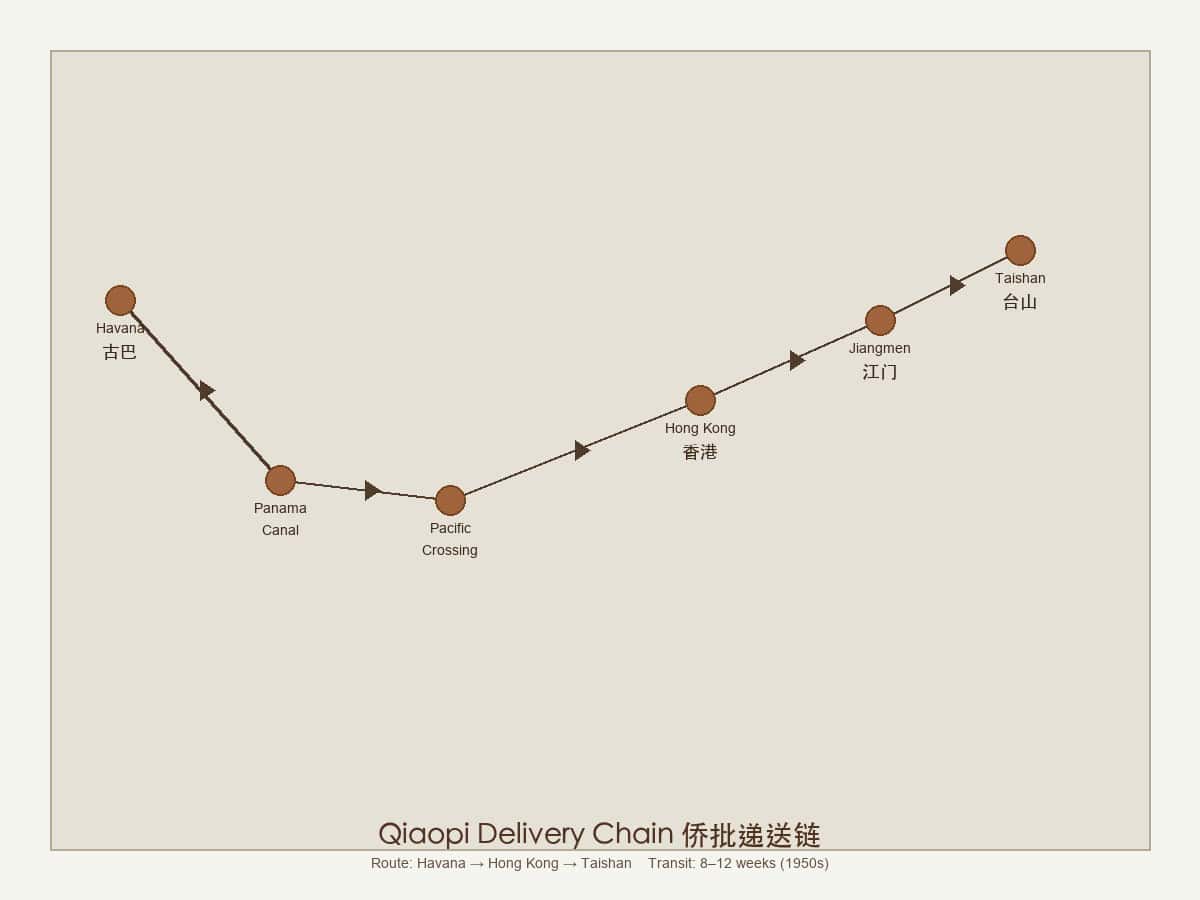
Framing to carry: The letters moved through couriers \— shuike and pijiao (\水\客/\批\脚, shu\ǐk\è/p\īji\ǎo \— traveling couriers and letter carriers) who crossed the Pacific with bags of envelopes and silver, decades before banks served the emigrant trade. In wartime the routes were rerouted and remade: letters that took months, survived blockades, arrived with the money still inside. In 2013 UNESCO inscribed the qiaopi archives on the Memory of the World Register \— roughly 170,000 remittance letters from Guangdong’s qiaoxiang regions, the province’s first world-memory heritage. Qiaopi are the documentary link between the letters and the buildings you’ll see in Kaiping: correspondence made concrete. The fuller story \— including both registers of “eating remittances” (\食\侨\汇, sh\í qi\áohu\ì), lifeline for some families and dependency for others \— is told in our 200-year diaspora history and in our beginner’s guide to qiaopi.
\n
Afternoon (sacred buffer): Nothing scheduled. Revisit Haikoubu’s yinxin memorial plaza if you wish, or rest. The documented arc of roots travel runs anxiety \→ catharsis \→ nostalgia, and the mixed feelings \— pride, guilt, alienation \— are part of the return, not a failure of it. Give them the afternoon.
\n
Evening: Light dinner, early night. Sleep: Taicheng, second night \— accommodation. Budget: museums free \— budgeting.
\n
Day 4 \— Taicheng: The Railroad the Villagers Built
\n
Base: Taicheng. Beat: awe and pride \— remittances as legible philanthropy.
\n
Morning: The Sunning Railway (\新\宁\铁\路, X\īnn\íng ti\ěl\ù, 1906\–1920) \— the overseas-funded line built on the capital and vision of Chen Yixi (\陈\宜\禧), who returned from America to build it. It never paid for itself and transformed the county anyway. Find the statue of Chen and whatever track remnants survive. Then Taishan No. 1 Middle School (\台\山\一\中), a school built by remittance money \— philanthropy you can read in brick.
\n

\n
Afternoon: The Taicheng historic district, where 1,191 overseas-Chinese buildings are managed under a “one building, one file” system, plus the qilou streets that made the county seat a market-town anchor. Optional: Guanghai Wharf (\广\海\码\头), 15 kilometers out, for the coastal departure layer.
\n
Optional leisure extension (skip in the 7-day plan): The Shangchuan and Xiachuan islands (\上\川/\下\川) \— ferry from Shanzui Port, hourly 8:30\–17:30 in season, better as an overnight; last return around 17:15\–18:00. Shangchuan has a Maritime Silk Road museum and beaches. Weather cancels ferries, so check the shipping notice first.
\n
Evening: Taicheng, and the decision point: islands tomorrow, or straight on to Kaiping. Transfers: local; Guanghai and Shanzui need a car. Sleep: Taicheng third night, or the islands. Budget: island ferry and shuttle roughly \¥32\–37 \— budgeting.
\n
Day 5 \— Kaiping, Tower Vocabulary: Learning to Read the Towers
\n
Base: Tangkou town (the scenic hub) or Sanbu. Beat: awe begins \— every tower a transnational building.
\n
Morning: Transfer from Taishan \— about 10 minutes by HSR to Kaiping South, or 30 by car on the new expressway. Go first to Yinglong Tower (\迎\龙\楼, Y\íngl\óng L\óu) in Sanmenli village, the oldest surviving diaolou (\碉\楼, di\āol\óu \— fortified tower-house), built in the 16th century \— before the grand examples mislead you. This is the vocabulary lesson: the typology of julou, zhonglou, and genglou (\居\楼/\众\楼/\更\楼, j\ūl\óu / zh\òngl\óu / g\ēngl\óu \— residential, communal, and watchtowers). Once you can read the types, every tower in Kaiping opens.
\n

\n
Afternoon: The Tangkou 5A scenic circuit. Zili Village (\自\力\村) keeps 15 towers, including Mingshi Tower (\铭\石\楼) and Yunhuan Tower (\云\幻\楼); Majianglong (\马\降\龙) in Baihe township is the other anchor. The five-point pass \— Li Garden, Zili, Majianglong, Jinjiangli, Nanlou \— costs \¥180, valid two days with one entry per site; the scenic shuttle (Zili\–Li Garden\–Chikan\–Majianglong) is free with the pass. Prices change, so confirm via the scenic area’s official channel. Jinjiangli sits about 20 kilometers off the shuttle route \— defer it to Day 7’s countryside drive.
\n
Evening: Tangkou Old Market (\塘\口\旧\墟) \— the Avant-garde Granary Bookstore (\先\锋\天\下\粮\仓\书\店), TK-Space in a converted watch factory, the Cangdong heritage-education base. Sleep in Tangkou’s guesthouses or back in Sanbu.
\n
Honesty interlude \— who owns the qiaoxiang story? Many towers stand locked, their owners abroad; a large share of the region’s diaolou, villas, and houses sit in a neglect heritage officials call “unmanaged” (\失\管). Heritage tourism here is both state strategy and a living village economy, and the polished resort at Chikan is not the whole story. The towers you can enter are the ones someone decided to open \— worth remembering.
\n
Sleep: Tangkou or Sanbu \— accommodation. Budget: the \¥180 pass is the hinge purchase of the Kaiping leg \— budgeting, and verify current prices.
\n
Day 6 \— Chikan: The Town They Built Twice
\n
Base: Tangkou or Sanbu. Beat: texture \— the built environment as layered return history.
\n
Morning: Chikan (\赤\坎, Ch\ìk\ǎn), the 371-year-old river town with more than 600 qilou \— the largest, most continuous, best-preserved arcaded-street group in China, about three kilometers of covered sidewalks. Its clan libraries \— the Situ and Guan clan libraries (\司\徒\氏/\关\族) \— were built by clansmen abroad who wanted their hometown to read.
\n

\n
Afternoon: The “Canada Village” (\加\拿\大\村) layer \— villages rebuilt by returnees to mirror the overseas townships they’d lived in, return history poured in brick and stucco. Then do as Chikan does: 3:30 afternoon tea (\三\点\三), the town’s ritual snack hour.
\n
Evening: Chikan at night \— lit qilou, the tram (\铛\铛\车, about \¥50), the punt boats (\摇\橹\船, about \¥80). Hours run to 22:00, so the evening block works. Logistics flag: ticket prices conflict across sources (adult entry anywhere from \¥60 to \¥145, with combos available) \— verify the current ticket via the resort’s official channel.
\n
Transfers: the scenic shuttle or a short taxi from Tangkou. Sleep: a Chikan resort guesthouse, or back to Tangkou \— accommodation. Budget: Chikan’s ticket plus tram and boat are optional \— budgeting.
\n
Day 7 \— The Named-Tower Pilgrimage: Your Family’s Tower
\n
Base: Tangkou. Beat: awe peak \— for Kaiping descendants, the catharsis-adjacent day.
\n
Morning: Li Garden (\立\园, L\ì Yu\án) in Gengcun village \— the Chinese-garden-meets-Western-mansion fusion (\中\西\合\璧) built by a returned emigrant, included in the five-point pass.
\n

\n
Afternoon: The countryside drive \— Xian’gang and Baihe (\蚬\冈/\百\合) townships, towers standing in the rice paddies, and Jinjiangli for Ruishi Tower (\瑞\石\楼), the tallest of them all at about nine storeys. This is the named-tower pilgrimage: Mingshi, Ruishi, Yunhuan \— each carries specific family stories, documented owners, inscriptions on the walls. For Kaiping descendants this afternoon is the personalization slot: if your family’s tower is among the named ones, this is your monument. Keep it flexible.
\n

\n
Transfers: hire a car or use Didi \— Jinjiangli to Zili is about 20 kilometers with sparse buses. Logistics flag: the pass allows one entry per site; revisiting a named tower may need a single-site ticket (\¥50\–100) \— confirm pass terms first. Meals: village lunch in Xian’gang or Baihe \— the food guide knows the dumplings. Sleep: Tangkou or Sanbu \— accommodation.
\n
Day 8 \— Enping: The County Everyone Skips
\n
Base: Encheng. Beat: contrast and surprise \— the least-visited county holds the least-known story.
\n
Morning: HSR from Kaiping South to Enping, about 19 minutes, then Xima Scholar Village (\歇\马\举\人\村) in Shengtang township \— the counterpoint to the migrant-village narrative: a village famed for imperial examination scholars, a different ambition in the same valley.
\n
Afternoon: The Enping Latin America Overseas Chinese Exhibition Hall (\恩\平\拉\美\华\侨\华\人\展\览\馆), opened in 2021, tells the story most visitors never hear: Enping’s diaspora numbers about 627,700 across 114 countries, with roughly 200,000 in Venezuela alone \— Latin America is more than half of the county’s overseas population. The first recorded Enping migrant to Venezuela left from Songxiang village in Shahu township in the late Qing. Enping has its own diaolou and villa countryside, quieter than Kaiping’s. (Hours for the exhibition hall were not confirmed at research time \— check before you go.)
\n

\n
Evening: The hot springs \— Jinjiang Hot Spring (\锦\江\温\泉, 4A, 52 pools) or Imperial Capital Hot Spring (\帝\都\温\泉) \— a deliberate buffer after Kaiping’s awe. Enping brands itself “the hometown of hot springs in China”; hotels sell out in winter and holidays, so book ahead.
\n
Personalization note: if your family is from Enping, this is your anchor leg \— the Latin America galleries are why this county is in the itinerary at all.
\n
Transfers: HSR plus taxi or Didi. Sleep: a hot-spring hotel (book early) or Encheng \— accommodation. Budget: the hot-spring stay is the trip’s splurge line \— budgeting.
\n
Day 9 \— Heshan and Xinhui: The Cultural Backbone
\n
Base: Huicheng. Beat: light texture before the rites peak \— the region that produced modern China’s reformers.
\n
Morning: HSR from Enping to Jiangmen (about an hour via Taishan) or drive. Then the Liang Qichao Former Residence Memorial (\梁\启\超\故\居\纪\念\馆) in Chakeng village (\茶\坑\村): free, Tuesday to Sunday 9:00\–17:00 (last entry 16:30, closed Mondays), a national protected site. Liang Qichao, the reformer who shaped modern Chinese thought, was born here; the residence sits in the 4A “Liang Qichao’s Hometown and Bird Paradise” area, where school groups still recite his Young China (\《\少\年\中\国\说\》) in the courtyard.
\n

\n
Afternoon: The Bird Paradise (\小\鸟\天\堂) wetland park, made famous by Ba Jin’s essay “The Paradise of Birds” \— an island of banyan trees inhabited by tens of thousands of egrets; entry and boat fees run \¥25\–65 across sources, so verify. Then the shopping stop: Xinhui chenpi (\陈\皮, ch\énp\í \— aged tangerine peel), along the Chenpi Ancient Road (food guide covers peel-infused dishes). Optional if time allows: Gulao Water Town (\古\劳\水\乡) in Heshan \— the canal-and-lotus wetland village, now partly a resort (ticket status unconfirmed \— check) \— and the Wing Chun lineage of Leung Jan (\梁\赞), the martial art’s Heshan cradle.
\n
Personalization note: for Heshan and Xinhui families, the orientation runs to Southeast Asia; the Wing Chun and Liang Qichao layers are the leg’s pride.
\n
Transfers: HSR plus taxi; the Heshan legs need a car. Sleep: Huicheng or back to Jiangmen \— accommodation. Budget: the residence is free; the boat fee is the only real cost \— budgeting.
\n
Day 10 \— Return to Jiangmen: The Day You Keep Open
\n
Base: Jiangmen. Beat: the trip’s peak \— catharsis at the grave or hall; nostalgia begins the moment it’s over.
\n
Morning \— the rites window: This is the day the schedule serves, not the other way around. Jizu (\祭\祖, j\ìz\ǔ \— ancestral rites) and baishan \— the ancestral house (\祖\屋, z\ǔw\ū), the graves, tea poured at the headstone \— are scheduled but deliberately flexible. If village rites already happened on an earlier day (Days 2, 4, or 5), this window absorbs what remains \— the graves you haven’t reached, the genealogy update you promised, the final courtesy call to the qiaolian. There is no deadline inside it.
\n

\n
Afternoon \— archives and closure: Follow up on the research layer: the Jiangmen Municipal Archives’ genealogy platform, Wuyi University’s Qiaoxiang Culture Research Center (0750-3299241) for deeper qiaopi access. Complete the reception loop \— thank-you banquets, renqing closure. If your village prints a qiaokan, make sure they know your name and address; the diaspora channel runs both ways.
\n
Evening \— departure prep: Jiangmen Station to Guangzhou South is 30\–38 minutes \— see the visa and route guide for onward connections. Then one last riverside walk through the qilou, which will look different now.
\n
Sleep: Jiangmen, or an overnight flight. Budget: the archives are free; the farewell banquet is the renqing line \— budgeting.
\n
The 7-Day Variant: When You Only Have a Week
\n
If ten days aren’t available, compress by rule, not by instinct. Day 1 (Jiangmen orientation) stands. Taishan takes two days: Day 2 is Haikoubu, Mei Family Mansion, and Fuyue Village; Day 3 is the qiaopi day at the Taishan Overseas Chinese Culture Museum, buffer dropped. Kaiping compresses to two days: Day 4 is Yinglong Tower, Zili, and Majianglong with a Chikan evening; Day 5 is Li Garden plus the Jinjiangli/Ruishi countryside drive, dropping the second countryside pass. Day 6 is Enping’s half-day \— exhibition hall and Xima Scholar Village \— with the hot-spring evening. Day 7 is Heshan/Xinhui (Liang Qichao’s residence plus Bird Paradise) with a flexible rites window. Drop the islands entirely. The rule of thumb: the qiaopi day and one tower circuit are non-negotiable; everything else yields. The budgeting guide has a 7-day cost line; the accommodation guide covers fewer base changes.
\n
Personalization Swaps: If Your Family Is From\…
\n
| County | Diaspora destination | Anchor days | Named stops that carry the story | Archives that hold the records |
|---|---|---|---|---|
| Taishan (\台\山) | North America \— 1.6M+ across 107 countries, Americas roughly 56% | Days 2\–4 | Haikoubu port, Taishan Yinxin Museum, Mei Family Mansion, Sunning Railway, Taishan No. 1 Middle School | Taishan Overseas Chinese Culture Museum; Jiangmen Municipal Archives |
| Kaiping (\开\平) | Canada and the United States | Days 5\–7 | Zili’s Mingshi/Yunhuan Towers, Ruishi Tower, Canada Village, Chikan clan libraries | Kaiping museum network; Wuyi University qiaopi collection |
| Enping (\恩\平) | Latin America \— ~627,700 across 114 countries, ~200,000 in Venezuela | Day 8 | Enping Latin America Exhibition Hall, Xima Scholar Village | Enping exhibition hall; Wuyi University qiaopi collection |
| Heshan/Xinhui (\鹤\山/\新\会) | Southeast Asia | Day 9 | Liang Qichao’s residence, Bird Paradise, Gulao Water Town, Wing Chun lineage | Jiangmen Municipal Archives; Xinhui county records |
\n
The surname-to-village guide and the roots-trip compass go deeper on turning a surname into a village and a door.
\n
The Village Knows Your Name Now
\n
The route was ten days. The story it reenacts took a hundred and fifty years.
\n
You arrived with anxiety and you’ll leave with nostalgia \— and the mixed feelings in between, the pride and the guilt and the moments of alienation, are part of the return, not a failure of it. The buildings you walked through were built by people who never stopped writing home. The letters were the first itinerary: ports, ships, couriers \— a geography of longing this plan simply updated. What you did this week \— walked the departure port, read the letters, stood in the ancestral house, poured tea at the grave \— continues the loop. Luoye guigen is not a destination; it is a practice. The village now knows your name, and the qiaokan will carry news of this visit as it has for a hundred years. The diaspora channel still runs both ways. Somewhere in the next generation, someone will read about the descendant who came home \— and the search begins again.
\n
Continue Reading
\n
- \n
- Visa and Route Guide \— arrival logistics and rail
- Plan Your Roots Trip: A First-Timer’s Guide \— the broader first-visit blueprint
- Budgeting Your Wuyi Roots Trip \— per-day costs and social-obligation lines
- Wuyi Food Guide for Returning Diaspora \— what to eat, county by county
- Wuyi Roots Trip Accommodation Guide \— base towns and guesthouses
- From Surname to Ancestral Village \— turning your family name into a village
- Wuyi Diaspora: 200 Years of Leaving and Returning \— the history behind every stop
\n
\n
\n
\n
\n
\n
\n
\n
Stay Connected
\n
Follow RootsOfChina on Facebook and Instagram for new article updates, behind-the-scenes from Kaiping, and stories from the Chinese diaspora.
\n
Sources
\n
- \n
- \梅\伟\强\、\张\国\雄. \五\邑\华\侨\华\人\史 (History of the Wuyi Overseas Chinese). \广\东\高\等\教\育\出\版\社, 2001.
- \张\应\龙. \广\东\台\山\华\侨\史 (History of the Taishan Overseas Chinese). \广\东\人\民\出\版\社, 2010.
- \刘\进. \银\信\与\五\邑\侨\乡\社\会 (Qiaopi and Wuyi Qiaoxiang Society). \广\东\人\民\出\版\社, 2011.
- Hsu, Madeline Y. Dreaming of Gold, Dreaming of Home: Transnationalism and Migration Between the United States and South China, 1882\–1943. Stanford University Press, 2000.
- \张\国\雄. \开\平\碉\楼\与\村\落 (Kaiping Diaolou and Villages). \中\国\华\侨\出\版\社, 2008.
- Kuah-Pearce, Khun Eng. Rebuilding the Ancestral Village: Singaporeans in China. NUS Press / Hong Kong University Press, 2011.
- Kaiping Diaolou and Villages \— UNESCO World Heritage Centre
- Qiaopi and Yinxin Correspondence \— UNESCO Memory of the World Register
- Jiangmen Municipal Government \— official tourism and heritage information
- Taishan cultural-tourism information \— cnts.gov.cn
- Wuyi University Guangdong Qiaoxiang Culture Research Center
- Enping Municipal Government \— county overview and diaspora statistics
\n
\n
\n
\n
\n
\n
\n
\n
\n
\n
\n
\n
\n\n
Never Miss a Story
\n
Join fellow descendants uncovering their Wuyi roots — get our weekly digest of new stories, surname guides, and roots-trip tips.
\n
\n\n
Suggested Reading
Is this your family’s story?
Roots Of China is built from readers’ family histories. If a story here sounds like your own — a surname, a village, a journey — leave a comment below, or share your family’s story with us and we may be able to help you find your ancestral village.
